Poetic Meter Resource Index
Meter Quick Links
← Poetic Meter Resource Index
← Poetic Meter Forum Threads
← Poetic Meter Excel Docs + Webpages
← Poetic Meter Word Docs + Webpages
← Downloads Index (All Files)
An indexing of all of the Poetic Meter related videos, pages, and resources: for those who would like to view everything in a single pane of glass. Please be advised that all of the below embedded YouTube videos may take a moment to cache from YouTube. All of the documentation and videos are long and complicated — really this is years of research — but I've done my best to condense it along with web page conversions of the .doc and .xls files (if viewing them directly in a web browser is preferred).
Index:
- Bible Book Dates
- God's Original Deadlines
- Jewish Calendar & Priestly Courses (1 Chronicles 24), Predict & Depict All History
- The Flood Chronology: A Paradigmal Calendar of Time?
Supplemental Worksheets
- AmenAnaphoraR.xls AKA Amen Anaphora Revised: Anaphora worksheet to test efficacy of Amen anaphora distancing (totals should seven or three, if syllable counts are likely right).
- GeneYrs.xls AKA Genesis Years AKA God's Orchestration of Time (to Bless Mankind): Timeline From Adam forward, shows how God's Rules for Time affect history both in Bible and post-Bible. All worksheet dates are taken from Bible; no astrology, astronomy, or extra-Biblical 'sources'. Just count the dates as Bible gives them, and be sure to count in solar years. Lunar accounting is a Jewish convention; but Bible's calendar is always based on birthdays, from Adam forward; so is always solar; God bid Israel use a solar year, Exodus 12. So the worksheet Column G (in yellow) dates tally to Bible. ('Our' BC/AD dates are sometimes 3 years off, which timeline also reflects. You can't fix it, by moving the timeline up three years. There are two self-cancelling errors in our calendars; that's why some of our BC/AD dates are right; some chronologers only make one or the other, error. Bible's timeline is self-auditing).
- HEBCalConverter.xls AKA Hebrew Calendar Converter: a worksheet plotting the seeming Noahic precedence upon the Hebrew calendar, including major historical dates Bible furnishes. Idea is to see orchestration of time in a recurring annual pattern.
- Intercal.xls: to see how brilliantly the Bible intersects both vernal and autumnal equinoxes had Israel (and we Christians with our equally-bad calendars) OBEYED THE BIBLE'S DATING SYSTEM.
- Judges.xls: video worksheet reconciling Psalm 90 and Book of Judges.
- MagnificatCalendar.xls AKA Magnificat Meter Time reference is based on Chanukah: showing the countdown from Antiochus IV and Chanukah, which Mary 'maps'. Column F is yet incomplete. Dates are shown in 'our' errant BC/AD system, as well as in Roman AUC calendar, which I suspect Mary and Paul use. Still testing that idea.
- TribChrono.xls AKA Tribulation Chronology Daily 'Map': Tribulation Timeline.
Downloads to the Excel documents are located on the webpages themselves (if you need to use them for live calculations, be advised they may work best with Excel 2003 as Excel has poor compatibility across versions). "God's Original Deadlines" has been integrated into this page, below.
Extremely Obsolete
- Isa53trans.htm: Isaiah 53 poetic translation, it has 3 translations & full exegesis. Extremely obsolete now.
- BibleHebrewMeter.htm: Initial document on the Meter Rules. Extremely obsolete now.
Supplemental Webpages
- Bible Hebrew Time Meter Characteristics: the latest update on the Meter Rules. All further refinements of the Meter Rules will be codified there. Diagnostic of 30 identifiable characteristics in Bible Hebrew and Greek meter, plus troubleshooting tips. There are 30 rules or characteristics in a Time Poem (for lack of a better term) that make analysis, self-auditing. So parsing mistakes stick out; helps one properly diagnose whether a passage really is a Time Poem. You can use it to test any passage in Bible for meter. Included are hints on how to find such passages; plus (passim), a tentative shortlist of them.
- Ten Ways this Timeline differs from what's 'out there'; Why this timeline balances to Bible dates.: this document briefly summarizes timeline rules and explains the scholar errors, i.e., human king's decree in Daniel 9:25; lunar years; ignoring 1 Kings 6:1 on David's death age (77), and instead preferring Josephus, etc. It also goes into the accounting relationship between 70 and 50, vital to how Paul crafts and 'nests' his own meter.
- God's Play of History: Psalm 90, Isaiah 53, Daniel 9 and Ephesians 1:3-14: God's Play of History Hebrew Meter style and integration (among said verses). It extensively documents Daniel's use of meter to track Israel's history and craft the 490 he requests from God, syllable by syllable, with cross-references to the specific Kings and Chronicles passages, Daniel has in mind when he talks. Will change how you read, Daniel 9. Very shocking and witty. A copy of Footnote E now resides also in the DAN9V4-19HebOnePagerParsed documents.
- Ephesians 1:3-14, Paul's Meter of Church Time: master summary of Bible Time Accounting Meter import. This covers Paul's meter, which is the most sophisticated of all. Turns out Paul's meter is based on Mary's; both seem to use Roman AUC to plot their meters: it's their own Anno Domini (so either means Christ was born at the end of 4BC or 2BC, depending on which AUC they use).
- Mirroring Timeline: How God Orchestrates Time: One must balance all the way back to Adam, to verify interpretation of any date or accounting. GeneYrs.xls is from Adam based solely on Bible. Mirroring itself explains God's Time-Grant construct with Bible verses you'd need to vet the math.
- Passover Plot: Shows we can know from the Bible, exactly when the Lord was born and died, and that between His Arrest and Crucifixion, there were four days, not one. Jesus' 25 Chislev 4BC (Chanukah, OT predicted in Haggai!) Birthdate and Passion Week AKA Passover timeline. Bible documentation there is extensive, and will take you months to vet; for God designed Israel's calendar around the Christ, just as Hebrews 1:2 says (in Greek). There's really no excuse for our centuries of confusion.
- brainoutFAQ.htm#6: read it through 6b. Shorter display of the Biblicity of Bible dates used in the 'Mirroring Timeline' and GeneYrs.xls.
- Revelation: a Play within a Play + John's Revelation 'Map': parse Revelation's timeline, since John wrote it as a simple Greek quadrilogy + a comprehensive companion outline of Revelation.
- Lord vs. Satan Part 2: Rapture's Legal Precedence goes back to Abraham.
- Lord vs. Satan Part 4a: a more thorough review from Christ's First Advent.
- The Bridal Contract for Church: Comparison chart of Israel's covenant versus Church (partial, tracks 16 major differences).
- Camping's Timeline Gaffes: Harold Camping misused Bible to craft his Doomsday dates; so, he used the wrong Flood dates, even. If you're interested, I refuted his calculations here. I couldn't have done it so well if I didn't know the meter. What attracted people to Camping was his alleged precision with Bible timelines. Well, the REAL Bible's precision makes his fake timeline look like the LXX begats' bungling, in Genesis 5!
- Case Study in Flawed Dating of Exodus: how the Bible's date (1440 bc) obviously dovetails with history we know.
- HOW-TO & SYLLABUS: how to calculate meter & historical trends.
- It acts as a form of error-correction to heal itself from scribal transcription errors, copy errors, malicious additions etc.
- It creates a layer of extra information to virtualize:
- A solar calendar to map time: important for timed doctrine for application, Christians need to be aware of what's happening although the majority will ignore this and succumb to things like claiming the 'End Times' for every major calamity or being obsessed with Prolife/Physical blood of Christ
- It tracks historical events: nobody will be able to use the excuse that the Bible isn't divine nor that God provided no evidence; ignoring secular proofs like God's character being written in every atom.
- A dateline for precise dating of each book and therefore the order of which they were written:
Bible Book Dates
| Book Name | Year Written | Notes |
|---|---|---|
| Matthew | 30 AD | Certifiably the first book in the New Testament; major doctrines route back here |
| Galatians | 49 AD | By Paul |
| James | 50 AD | |
| 1 & 2 Thessalonians | 53 AD | By Paul |
| 1 & 2 Corinthians | 54/55 AD | By Paul |
| Romans | 56 AD | By Paul |
| Luke | 58 AD | |
| Philippians | 60 AD | By Paul |
| Philemon | 60 AD | By Paul |
| Acts | 62 AD | By Luke |
| Colossians | 62 AD | By Paul |
| Ephesians | 62-63 AD | By Paul |
| 1 & 2 Timothy | 66/65 AD | By Paul |
| Titus | 66 AD | Post-Paul, Paul dies: year of the four emperors begins |
| 1 & 2 Peter | 68 AD | Post-Paul |
| Jude | 68 AD | Lord's brother, succeeded after James was murdered. Jude is in exile |
| Hebrews | 68 AD | Post-Paul |
| Mark | 69 AD | |
| John | 77 AD | |
| 1 & 2 & 3 John | 77 AD | |
| Revelation | 88 AD | Certifiably the last book as it 'bookends' everything prior |
- It helps recover lost pronunciation, the meter is influenced by syllables which in turn forces pronunciation, otherwise the math won't work.
- It acts as a form of memorization aide, especially useful in times where there were no computers where they would 'sing' it, this phenomenon in modern times has found its way into SM64 'beatcounting' which is used for blind folded speedruns, if the time in the game is metered you can know where a moving platform will be without having to see it. They also used the metering for reference since none of believers in the Old Testament or New Testament days used 'verses' as we do today.
- This is probably why followers of Hinduism and Islam are encouraged to 'sing' their holy books in their languages: if we are under the assumption the demons are eager to parody this in their own home-grown religions while ensuring nobody sings the Bible in the original languages anymore, you'll never see Christians singing the metered Greek anywhere, and especially never Hebrew 🤔. Of course many will disagree with this despite the fact the Qur'an and Bhagavad Gita plagiarize and reverse nearly every major doctrine in the Bible: few have studied all books in tandem to notice this.
- It acts as an unequivocal method to determine which books are canonical and which ones aren't (apocryphal books cannot be metered), this also means there are no 'lost' books as the meter requires all genuine books to be extant.
- It acts as undeniable proof the original language texts are inhuman pieces of literature; it's impossible to meter multiple languages across multiple time periods across mutiple writing styles and somehow still be consistent, all the while still virtualizing a solar calendar behind the scenes.
- A hermeneutic for textual interpretation and context.
- A concordance for cross-referencing related passages and calling back to others.
We have to assume if God existed and He wanted the original language texts preserved through imperfect copies, there would have to be a method to accomplish all of the above, and so there is: the poetic meter. Is the entire Bible metered? It would have to be given God's method of using copies of manuscripts and also due to the fact the time of the rapture isn't known (which means that meter goes on for a long time 😅); but finding every meter everywhere and how it all ties in with each book would require a substantial amount of research which nobody's bothered to do yet; and the people who were aware of it never bothered to find the correct integers to meter with. It will require many lifetimes of research to meter the entire Bible.
Therefore the Poetic Meter also means that: no translation is inspired (translations cannot be metered) and no books are missing, otherwise the math will fail, eventually at least (also technically there being '66' books is a trinity number and a big hint that it's the right amount: which is also why '12' apostles and '24' elders are also numbers divisible by 3). This has nothing to do with the modern conspiratorial 'Bible Codes' or I Ching or coincidences but the raw syllables in the languages themselves, there's no guessing or assumptions or statistics: the metering is entirely dependent on the languages. The Masoretes were apparently aware of this to a certain extent as for sevening they put the appropriate punctuation to match.
This unfortunately also means that while we have all of the copies of every manuscript available, nobody has metered all of the manuscripts to rebuild a 100% perfect Bible even though it's possible, little minor errors will always persist without the Poetic Meter's error correction applied; this applies to most things in life which is why our DNA needs error correction, why computers need error correction, why we need to proofread etc.
This is therefore, one of the largest and most important doctrines in Christianity that Christendom has ignored. It also subsequently decimates long contested misinformation and false doctrines extant in 90% of denominations, in a single swoop: no Preterism, no Peter-being-a-pope, no works salvation, no Calvinism, always pre-Tribulation Rapture, no screaming "the end times are here right now" (which every generation has been claiming post-Christ), no KJV-only, etc etc etc.
God's Original Deadlines
| BC or (AD) | Year of World | God Measures Time & Crafts Deadlines |
|---|---|---|
| 4106 | 0 | Man's Time Begins at Adam's Fall |
| 3616 | 490 | Qualifying Deadline for new 490-year time grant to be awarded a super-mature believer, else Time ends. |
| 3616-3546 | 490-560 | Voting period for BELIEVERS to choose God or not. |
| 3546 | 560 | Historical 560 accounting Deadline (at end of voting period) |
| 3126 | 980 | Qualifying Deadline for new 490-year time grant to be awarded. |
| 3106 | 1000 | Qualifying Deadline for new 1000 year time grant to be awarded a super-mature believer, else Time ends. |
| 3106-3056 | 1000-1050 | Voting period for the world to choose God or not. |
| 3056 | 1050 | Historical Deadline balancing 490-year accounting to 1050 unit. |
| 3056 | 1050 | Historical Deadline (at end of voting period), completion of 1050 unit. |
| 2636 | 1470 | Qualifying Deadline for new 490-year time grant to be awarded. |
| 2566 | 1540 | Historical 490 accounting deadline |
| 2566-2496 | 1540-1610 | Voting period for BELIEVERS to choose God or not. |
| 2496 | 1610 | Historical 560 accounting Deadline (at end of voting period) |
| 2146 | 1960 | Qualifying Deadline for new 490-year time grant to be awarded. |
| 2106 | 2000 | Qualifying Deadline for new 1000 year time grant to be awarded. |
| 2056-2006 | 2050-2100 | Voting period for the world to choose God or not. |
| 2006 | 2100 | Historical Deadline balancing 490-year accounting to 1050 unit. |
| 2006 | 2100 | Historical Deadline, completion of 1050 unit. |
| 1656 | 2450 | Qualifying Deadline for new 490-year time grant to be awarded. |
| 1516 | 2590 | Historical 490 accounting deadline |
| 1516-1446 | 2590-2660 | Voting period for BELIEVERS to choose God or not. |
| 1446 | 2660 | Historical 560 accounting Deadline (at end of voting period) |
| 1166 | 2940 | Qualifying Deadline for new 490-year time grant to be awarded. |
| 1106 | 3000 | Qualifying Deadline for new 1000 year time grant to be awarded. |
| 1006-956 | 3100-3150 | Voting period for the world to choose God or not. |
| 956 | 3150 | Historical Deadline balancing 490-year accounting to 1050 unit. |
| 956 | 3150 | Historical Deadline, completion of 1050 unit. |
| 676 | 3430 | Qualifying Deadline for new 490-year time grant to be awarded. |
| 466 | 3640 | Historical 490 accounting deadline |
| 466-396 | 3640-3710 | Voting period for BELIEVERS to choose God or not. |
| 396 | 3710 | Historical 560 accounting Deadline (at end of voting period) |
| 186 | 3920 | Qualifying Deadline for new 490-year time grant to be awarded. |
| 106 | 4000 | Qualifying Deadline for new 1000 year time grant to be awarded. |
| (44)-(94) | 4150-4200 | Voting period for the world to choose God or not. |
| (94) | 4200 | Historical Deadline balancing 490-year accounting to 1050 unit. |
| (94) | 4200 | Historical Deadline, completion of 1050 unit. |
| (304) | 4410 | Qualifying Deadline for new 490-year time grant to be awarded. |
| (584) | 4690 | Historical 490 accounting deadline |
| (584)-(654) | 4690-4760 | Voting period for BELIEVERS to choose God or not. |
| (654) | 4760 | Historical 560 accounting Deadline (at end of voting period) |
| (794) | 4900 | Qualifying Deadline for new 490-year time grant to be awarded. |
| (894) | 5000 | Qualifying Deadline for new 1000 year time grant to be awarded. |
| (1094)-(1144) | 5200-5250 | Voting period for the world to choose God or not. |
| (1144) | 5250 | Historical Deadline balancing 490-year accounting to 1050 unit. |
| (1144) | 5250 | Historical Deadline, completion of 1050 unit. |
| (1284) | 5390 | Qualifying Deadline for new 490-year time grant to be awarded. |
| (1634) | 5740 | Historical 490 accounting deadline |
| (1634)-(1704) | 5740-5810 | Voting period for BELIEVERS to choose God or not. |
| (1704) | 5810 | Historical 560 accounting Deadline (at end of voting period) |
| (1774) | 5880 | Qualifying Deadline for new 490-year time grant to be awarded. |
| (1894) | 6000 | Qualifying Deadline for new 1000 year time grant to be awarded. |
| (2144)-(2194) | 6250-6300 | Voting period for the world to choose God or not. |
| (2194) | 6300 | Historical Deadline balancing 490-year accounting to 1050 unit. |
| (2194) | 6300 | Historical Deadline, completion of 1050 unit. |
| (2264) | 6370 | Qualifying Deadline for new 490-year time grant to be awarded. |
Jewish Calendar & Priestly Courses (1 Chronicles 24), Predict & Depict All History
Sorry but I'm learning all of this piecemeal. It turns out also that the intercalation in the Bible should go by Elul not Adar. So this Jewish calendar is totally messed up. If you intercalate Elul you always hit the autumnal equinox on time. This prior stuff which talks about intercalating in Adar needs to be corrected, since I was an idiot and followed the scholarly writeups instead of doing the math from the beginning, myself. Israel used to intercalate at Elul, a guy named Sacha Stern wrote about that: Calendars in Antiquity: Empires, States, and Societies (page 254). (Stern is Research Fellow, Lecturer, then Senior Lecturer at Jews' College (now the London School of Jewish Studies), University of London, since 1990.)
Sorry to have to say all this, but it's time we Christians and Jews fixed our centuries-old mistakes instead of covering them up. Bible gets trashed when our interpretations of it, are wrong. Hopefully this generation of young folks (I'm too old to do it all) will start making good on the past errors. Errors are fine, to be expected. Covering them up? Not good.
Thanks to an email I just got today from someone else who's also doing the meters in other Bible books, I now know an error I'd been making for some years: my error, was to listen to the 'scholars' and the Jewish calendar practice of intercalating an Adar sheni. That is the wrong month for intercalation. The Bible uses Elul, and so did Israel, prior to the Exile, per the Talmud.
PATU32 demonstrates how you can easily fix the Jewish calendar to align with the Bible, and how it went wrong. Links to the books on the topic written by scholars about Elul intercalation, are in the description.
Upshot: begin the year at the autumnal equinox, 30 days per month except Elul gets 35 or 36 days. Simple. Always aligns with the equinoxes, because Jewish time begins sundown the prior solar day. Perfect. Every year, no muss no fuss. So why did Israel mess it up so much, and why do we Christians? Politics! The stupid Easter Computus is a stain on Christianity, and we never needed it, but to cover up the fact He died on what should have been Passover and rose on First Fruits, they invented East-Star. The Jews for their part, stopped intercalating in Elul because that's what the Babylonians did (never mind, that custom came from Daniel). Oh well.
This is really exciting stuff. At last we can see proof the Bible alone is right. Absent BibleWorks, I'd never have this proof. Best of all, it's Bible proof, so you can vet it yourself in Bible, and don't need some 'brainout' or 'scholar' to rely on! God is always right, we can all rely on His Word!
Added note: I'll have to fix my errors in PassPlot.htm and elsewhere, saying Adar intercalation. For it was supposed to be Elul. Where we prove the Elul intercalation in the Bible I don't yet know, but it's in there... somewhere.
To see how brilliantly the Bible intersects both vernal and autumnal equinoxes had Israel (and we Christians with our equally-bad calendars) obeyed the Bible's dating system, refer to Intercal.xls. You yourself will be able to finally celebrate all the Bible holidays on time if you use that, merely updating what is the equinox each year. For if you use the Jewish calendar or our stupid 'Easter computus' calendar, you'll get all the Bible holidays wrong.
Within each priestly course link are bullets of some of the significant dates. More dates will be added as I've time, but there won't be many more; I probably found all the ones I can in Bible, searching through BibleWorks. Bible-significant months which don't have specified days in the verse, are not generally listed. Bible doesn't usually give the exact date; but when it does specify an exact date -- especially, for a prophecy spoken -- it's important. So these are listed. If I missed one, would you mind letting me know?
| Month # | Gregorian Equivalent | Month Name | Holiday |
|---|---|---|---|
| 1 | Mar–Apr | Abib (=new barley) aka Nisan Sacred cal's 1st mo. |
Passover (10th, 14th, both starting at sunset) Unleavened Bread (14th at sunset through 21st at sunset) First Fruits, the first day of Weeks (usually starts on 21st or 22nd at sunset) |
| 2 | Apr–May | Ziv (=flowering) | -- |
| 3 | May–June | Sivan | Pentecost (ends Weeks, 50th day from First Fruits) |
| 4 | June–July | Tammuz | -- |
| 5 | July–Aug | Ab | Note: 9th of Ab is First and probably Second Temple’s destruction date. |
| 6 | Aug–Sept | Elul | Month should run 35–36 days, ending at the autumnal equinox. If Israel doesn’t observe that, intercalation should occur here. Post‑exile, they didn’t do it. |
| 7 | Sept–Oct | Ethanim (=flowing water or fruits) aka Tishri Civil cal's 1st mo. |
Rosh HaShanah (=New Year, 1st) Yom Kippur (=Day of Atonement, 10th) Succoth (=tents, booths, 15th–21st) |
| 8 | Oct–Nov | Bul aka Marcheshvan (Bul = rain) | -- |
| 9 | Nov–Dec | Chislev (=Foolish/Confident Heart) | Chanukah (from 25th Chislev until 2 Tebeth) |
| 10 | Dec–Jan | Tebeth (=muddy) | -- |
| 11 | Jan–Feb | Shebat | -- |
| 12 | Feb–Mar | Adar Israel instead used lunar months and every 3–6 years intercalated an “Adar Sheni” (=Adar II) of 15–30 days, so the calendar became inconsistent. |
Purim (14th or 14–15) |
NIV 1 Chronicles 24:7-18, the Priestly Course names which God told David to organize, back around 970 BC. Note how prophetic, the names:
Meaning Per Week in Each Nisan and Ethanim:
Days 1-7, 7 the first lot fell to Jehoiarib [God Has Brought Justice, Yah+rib, to be the Plaintiff in a trial],
- Nisan: Last Plague in Egypt set up this week, 1440 BC.
- Ethanim: 1st is RoshHashanah.
- First Temple is dedicated 1 Ethanim 950 BC, 1Kings 8:1.
- Nisan: 1-7, 715 BC, the Temple which had been desecrated by King Ahaz, was reopened, cleaned, and rededicated under son King Hezekiah's orders, 2 Chronicles 29. Imagine: the Temple had been closed and the lights put out by a son of David. So of course no Passover had been celebrated in years.
- Ethanim: sometime not long after 586 BC, Arab attempt to wipe out the remnant of Israel after First Temple destroyed, Jeremiah 41:1-15 and 2 Kings 25:25. Context of the beggars in Jeremiah 41:5 strongly points to them coming for the sake of Yom Kippur. Therefore the murder of Gedaliah (who was assigned to protect the Jews by Nebuchadnezzar) must have happened in the first week of Ethanim.
- 1 Ethanim, 538 BC: Babylonian captives have returned and settled in the Land, and begin Law observance preparatory to reconstructing the Temple under Cyrus' decree, Ezra 3:1ff, Nehemiah 7:73.
- Nisan: 1-7, 474 BC, casting of the purim to decide on what days Jews should be slaughtered, Esther 3:7.
- 1Ethanim, 446 BC, dedication after Jerusalem's Wall is finished, Nehemiah 8:2. On that day, the Law is read. Notice how they didn't even remember Booths, Nehemiah 8:14, but are excited by the news.
Days 8-15, the second to Jedaiah [God knows/knew, Yah+yada (terminating ayin) -- see 2 Corinthians 5:21],
- Nisan: Last Plague Occurs, Lamb Set Aside (10th), Original Passover lambs slain (14th at sundown), 1440 BC.
- Nisan: 10th day, 1400 BC, Israel crosses the Jordan into the Land, and camps at Gilgal (="foreskin", in Hebrew), Joshua 4:19. Idea that the stones are witnesses -- for or against their keeping the contract (see the same refrain at the end of Joshua, and passim in Old Testament). The idea of setting up a Stone as a Witness is at least as old as Abraham; that's why Jacob sets up a stone witness the night after he dreams of the stairway. The Wailing Wall is a Stone Witness to Daniel 9:26c, which of course no one reads, either. The Abomination of the Dome of the Rock is a 2nd Witness. Always got to have at least two.
- Nisan: 14th day, 1400 BC, Israel observes its first Passover in the Land, Joshua 5:10.
- Nisan: 15th day, 1400 BC, Israel eats of the produce of the Land, Joshua 5:11-15. This is a very pointed passage. It does not say that they observed First Fruits as commanded in Leviticus 23:10 and following. Moreover, they make unleavened meals out of it, clearly in observance of the Feast of Unleavened Bread. It doesn't say God approved of them doing this, but there's no clear condemnation, either. Of course, they had all just been circumcised, and couldn't exactly harvest anything. So they were probably gleaning. The manna of course, stops. Scholars seem to use this passage to claim First Fruits begins the day after Passover. But that makes no sense, especially since there's no claim it was observed, and they are eating in observance of Unleavened Bread. LXX clearly says they ate from new produce ("nea" in the LXX of Joshua 5:11). That's a violation, if no First Fruits offering; no observance of Weeks is noted, either. Clearly it's been presumed by scholars that they did observe. But then why doesn't God make an issue of this, what would be the first observance, since He makes an issue of Passover? Why is there no statement of Divine Approval, but rather an omnious appearance by an angel, and to Joshua? Yes, the Land is holy; but that doesn't mean the people are obedient, and no such statement praising them is made. Divine Omission is often a sign of disapproval, but no judgement for non-observance of First Fruits is mentioned, either. On the other hand, God talks to Joshua and says He's with Joshua, not Israel. Also, it says that Israel served the Lord during all the time of Joshua and of the elders who survived him, Joshua 24:31. On yet the other hand, the Deuteronomy 16:9ff description of First Fruits is predicated on the last day of Passover; same in Numbers 28:26, so the initial entry observence in Leviticus 23:10 and following. Could be a special case: and, the first sabbath which occurred after entry, was the Passover itself (a high sabbath, and maybe a regular sabbath, too). So I need to study the matter more.
- Ethanim: 10th is Yom Kippur, Day of Atonement.
- Ethanim: 14th at sundown begins Booths.
- Nisan: 15th (14th at sundown) begins Feast of Unleavened Bread to commemorate Egress from Egypt.
- Ethanim: week of Booths, celebrating 2nd harvest.
- Nisan: 13-14, 474 BC, the writing and publication of the Purim condemnation set for 14 Adar. Esther 3:12.
- Nisan: Christ is Arrested on the true 10th of Nisan, but 14 Nisan on the non-intercalated calendar that year, 30 AD; that is the 1470th anniversary of the original day the lambs were commanded to be set aside.
- 30 AD, true 14 Nisan (but 18 on the calendar that year) Christ is crucified; thus He 'knows' sin by being made sin, so thereby pays for the sins of all mankind (Isaiah 53:3-12, 2 Corinthians 5:21); just afterwards, between 3-4pm, He dies on the Cross. It is thus the 1470th anniversary of the original slaying of the Passover lambs, occurring also before sundown.
- Nisan: Final Stage of Siege of Jerusalem begins on the 40th anniversary of His Crucifixion, 70 AD.
Days 16-22, 8 the third to Harim [Dedicated, devoted to destruction, haram cognate, plural],
- Nisan: Feast of Unleavened Bread lasts all week 15-21, and
- First Fruits piggybacks onto its last night,
- Kicking off Weeks.
- Ethanim: counterpart to Feast of Unleavened Bread is Booths, 15-21. It has no sacred, stated First Fruits counterpart or Weeks holiday, initially.
- 21 Ethanim (End of Booths), 521 BC: God ties Booths to Weeks (Pentecost's harvesting theme, kicked off by First Fruits, the parallel day in Nisan to 21 Ethanim) -- and, to 25 Chislev foundation of the Second Temple, -- all these threads, interweave as the main theme of Haggai 2. Note how God parallels the rhetoric of both the dates He gives the messages, the harvesting content, and the Seed Promise to Zerubbabel (whose name means Seed), in Haggai 2:1 with 2:6, 2:10, 15, 18-23. I don't know how God could be more blunt about what day is Messiah's birthday. How have we missed it for centuries?
Numbers 28:26 does the same thing, but it's mistranslated. However, I need to further analyze the deft piggybacking language, before retranslating it. That retranslation will appear in PassPlot.htm when finished. Right now, it's only a "comment" in the html source code, and you can't read it unless you View Source.
- On 21 Nisan 30 AD (post-sundown, so 22 Nisan officially), Christ Resurrects. This fulfills what God said to Zerubbabel in Haggai 2 -- literally. That is First Fruits day, both nominally on the Jewish calendar that year, and had the calendar been corrected (intercalated) that year. Um, only God can Converge Time despite it being off-kilter, k? Just as the Old Testament promised and the New Testament repeatedly stresses. (Old Testament Verses are in the Introduction and Division#1; New Testament verses are in Division #2, both are links in PassPlot.htm.)
Days 23-30, the fourth to Seorim [Ripe barley, stressing its hairiness, plural],
- Nisan: Last Plagues, 1440 BC.
- Nisan: 24th, 536 BC, two years after Daniel 9, Daniel gets another visit from Gabriel while mourning for the dead King Darius the Mede, Daniel 10. Very revealing portrait of how the angels themselves battle. Chapters 10-12 are a single visitation. The event has immediate relevance because the Temple had just commenced rebuilding, the foundation had been laid 25 Chislev 537 BC (Haggai 1:15 plus Ezra 3:10), and Persia had sponsored it. But then.. Halt. So now we know why: there was a battle in heaven over the event. This tells you angels are free agents namely, Daniel 10:13, Gabriel was delayed, meaning to come to Daniel on 3 Nisan 536 BC so he got reinforcement from Michael, and the "kings" they fought with are angelic; so he'd have to go back to fight, 10:20. So the future outcome through the end of time is sketched out in more detail for Daniel to know and write down for Israel.. And for us. So use of the "twenty-fourth" in Daniel 10:4 is a significant doctrinal message. It ties back to the event of Haggai 2, God's moving heaven and earth in honor of 24 Chislev. See, you date a thing by some important event, in ancient times, and time is reckoned in years from a king, an exile, etc. So here, the 24th is important. You'll see the same dating usage of the 24th post-Haggai 2:15-23, in Zechariah, Nehemiah (wall finished 24th Elul, Nehemiah 6:15; fasting a month later in Ethanim -- on the 24th, not only on the 10th -- Nehemiah 9:1). All of these 24th references are return-from-Exile references: Nehemiah 9:1, Daniel 10:4, Haggai 1:15, Haggai 2:10, Haggai 2:18 (the precedent, which I'd bet is predicated on the same date for David, somewhere); Haggai 2:20 (same), Zechariah 1:7.
- Ethanim:
Meaning Per Week in Each Ziv and Bul:
Days 1-7, 9 the fifth to Malkijah [God is My King, melek+Yah],
- Ziv: First Temple construction begun, 2 Ziv, 960 BC, 1Kings 6:1, 2 Chronicles 3:2.
- Bul: probably on the 2nd, First Temple construction completed, 953 BC (but the Temple isn't dedicated until nearly three years later).
Days 8-15, the sixth to Mijamin ["auspicious child", min+yamin],
- Bul: Babylon taken over by Persia, 11 Bul 538 BC (Marcheshevan), per historians.
- Ziv: 14th at Sundown, Hezekiah and Israel observes the Passover, 715 BC, 2 Chronicles 30:2 (see also Numbers 9:11 for why that date is valid). Took so long to clean the Temple after Ahaz had closed it, there wasn't enough time to observe the Passover in Nisan.
- Bul: Jeroboam institutes a pagan Passover like Aaron had done while Moses was up getting the Law the first time -- not sure what year, but it's set for Bul 15-21, and is sometime not too many years after 930 BC. See 1Kings 12:28, 32 in context. Jeroboam's line is destroyed by the fourth generation, and there is a long line of usurper-kings of Samaria, after that. I did not list their dates in GeneYrs.xls, because they aren't valid kings.
Days 16-22, 10 the seventh to Hakkoz [The Thornbush/Briar, ha+qots],
- Ziv: 20 Ziv, 1439 BC: Israel decamps, lead by the Holy Spirit (see also Isaiah 63, whole chapter which provides a panoramic structure on how Trinity coordinated to deliver Israel then and throughout history), Numbers 10:11.
- Bul:
Days 23-30, the eighth to Abijah [My Father is God, God Fathers, ab+i+Yah -- the "i" is a first-person singular suffix],
- Ziv or Bul: Israel wins her independence from the Seleucids, 23 Ziv (or Bul, unlikely) 141 BC, 1 Macc 13:51.
- Ziv:
- Bul:
Meaning Per Week in Each Sivan and Chislev:
Days 1-7, 11 the ninth to Jeshua [God is Salvation=Jesus' name, Yah+shua],
- Sivan: 1Sivan, 586 BC, two months before the Temple is to be razed, God has Ezekiel warn Egypt that it will be destroyed due to its pride, Ezekiel 31:1ff. By that time Jerusalem had been under siege. [I'm assuming the 597 BC exile is what he's dating from, since he left before the Temple was razed, given Ezekiel 1:2.]
- Chislev:
Days 8-15, the tenth to Shecaniah [God Dwells (in His House with us, especially in the First Temple at its Dedication), shakan+Yah],
- Sivan: 11 or 12, Pentecost, end of Weeks.
- Sivan: 11 or 12=Pentecost, 30 AD -- beginning of the Church "Age" (Pauline term, lexeme in Ephesians 3:21, "Age over the ages", always mistranslated).
- Sivan: 11 or 12, 4 BC. Date the Malachi-prophesied 'herald', John the Baptist, was born.
- Chislev: 11 or 12, the intercalated day on which Antiochus IV Ephiphanes put a pagan statue inside the Temple, 167 BC, presaging the abomination which has characterised the Temple Mount since 70 AD. Romans, Persians, Christians, Moslems have all built something atop that Mount, fulfilling Matthew 24. In the Tribulation, Daniel 9:27 depicts yet another abominator, and Revelation 11 makes fun of the alleged Temple then standing. For God Did not Want It. The Temple GOD wants will be built at the Second Advent by angels, theme of Ezekiel Chapters 39 and following (whole rest of the book).
- Chislev: 15th, the nominal day on which Antiochus did this, 167 BC, 1 Maccabees 1:57.
- Chislev: 11th=15th=25th in any year, depending on intercalation lapses. That would also be true of any other date relative to another, in history, though the 'spread' will of course vary.
Days 16-22, 12 the eleventh to Eliashib [My God Causes Return -- a kind of benediction, Eli+shub],
- Sivan:
- Chislev: Weird convocation on 20 Chislev, Ezra 10:1, 9 where Israel decides to put aside its foreign wives. Never do you see a verse saying God ordered this; never do you see a verse saying God was even consulted; all you see is weeping and wailing, led by Ezra. They decided to do this thing. Ezra ends on this note, in Chapter 10. Either part of Ezra is missing, or this is a very pointed statement about how quickly Israel went overboard legalistically. I'm not sure what year it is. But it might account for Nehemiah's going there in 446 BC. In Nehemiah 13:23ff, he reports the same problem, and he himself is upset about the foreign marriages; that year appears to be sometime after 432 BC or so, going by Nehemiah 13:6. These may be two instances. Again, no record of God's Attitude about it, but rather theirs.
Days 23-30, the twelfth to Jakim [God Rises Up -- think of all the entendres in English, including Rising up Exist on the Earth (most Hebrew common meaning), to Defend, Rising up to Testify, Win -- Yah+qum, see Isaiah 53:2 retranslation in Isa53trans.htm],
- 23 Sivan: reversing decree written to save the Jews, 474 BC, Esther 8:9. So it went out the next day, 24 Sivan.
- 24 Chislev, 537 BC: Second Temple foundation stone laid, Ezra 3:6,10 compared with Haggai 2:18.
- 24 Chislev, 521 BC: God makes Zerubbabel the seed line of Messiah, Haggai 2:23.
- 25 Chislev, 167 BC, Antiochus IV Ephiphanes desecrates the Holy of Holies with a pig sacrifice, 1 Maccabees 1:59.
- 24 Chislev post-sundown, 164 BC: original Chanukah, 1 Maccabees 4:52, 2 Maccabees 10. They actually held the service on the morning of 25 Chislev, but remember the 25th begins the night before. 2 Maccabees 10:5 significantly comments on how Chanukah was decided to be deliberately patterned after Booths. In light of what God says in Haggai 1:1 and following., timing His first message to occur on the Last Day of Booths 521 BC, the Maccabees must have made that connection here in 164 BC. Maybe that's why Antiochus picked 25 Chislev for a pig desecration, in the first place; maybe that's why he picked 15 Chislev too (adjusting for non-intercalated years). The founding date of the Temple would be a major date in the Jewish calendar any Jew would know and annually celebrate, especially given Haggai 2.
Matching Key → In the Jewish calendar, every elapse of a month makes the calendar run .43 days too fast. Thus the too-fastness of the calendar between Sivan and Chislev in absolute terms, is six months times .43, equalling 2.58 days. So relative to 11 Sivan (Pentecost), in a year when the calendar is otherwise non-intercalated, another 3 days must be subtracted from the Chislev date, to get the equivalent Sivan date in the past. So in 164 BC, 25 Chislev is equal to 11 Chislev and thus opposite 11 Sivan. They must have known this, to pick 25 Chislev yet tie it to Booths, not Passover. In short, they must have read Haggai 2's meaning and knew that 25 Chislev fills the slot opposite to Pentecost, tying up both Chanukah and Purim to be the opposite matching holiday in the calendar. Whether they also knew it would be Messiah's Birthday, is not as clear. But at least they knew the tying-together purpose of 25 Chislev, given their motive for choosing it and tying it to Booths.
- 24 Chislev post-sundown, 4 BC: the Lord is born in Bethlehem. The wise men are not there, they are busy in jerusalem asking people where He is; because they calculated when He'd be born, and then thought they saw some star leading them, but it disappeared. So they make a loud appearance and keep on asking, do you in Jerusalem know where He is? See Matthew 2 in Greek. During the next 40 days, the parents of that King are in Jerusalem as well, at Temple: since it's the Law to dedicate (at the Feast of Dedication, how apt) the Firstborn, and for the woman to do the birth purification there at Temple. So the magi are in the same town as the Royal Couple. So when the Royal Couple leave and go back to Nazareth (end Luke 2 and Matthew 2), well.. That angel who looks like a star to the magi, guards them. Thus the magi follow the angel who is no star (stars don't hover over houses, k) and finally find the child. That's how Herod would find the Child, too, and why Joseph and Mary have to high-tail it outta there that same night. See Deuteronomy 18 prohibition against astrology, to know God would never create a special star; see Bible to realize it never says any star was over Bethlehem or anywhere else (Matthew 1-2, Luke 1-2). Angels are called "stars" in the Bible.
Meaning Per Week in Each Tammuz and Tebeth:
Days 1-7, 13 the thirteenth to Huppah [Divine Protection from enemies, storms -- like during the wilderness period -- huppa=canopy],
- Tammuz: 5 Tammuz, probably 592 BC, Ezekiel 1:1 and following. Ezekiel gets his prophetic commission from God. Looks like the 30-year-old prophet is made mute, except when he prophesies. Need to research that more. He gets his commission in the prequel anniversary month of Nebuzaradan breaking through the city wall, which was on the 9th day of the fourth month in 586 BC, 2 Kings 25, Jeremiah 39:2. The wordplay on Tammuz is important. Tammuz was a Babylonian god. That a month would be named after him, that Israel was playing footsie with Tammuz, is pointedly referenced as part of the court case giving rise to God sending Nebuchadnezzar. Ezekiel rolls out this story vividly for the Babylonian exiles. So by Ezekiel 4, the prophet himself is made to lie down for 430 days, mutely playing the upcoming siege of Jerusalem blow-by-blow.
- Tebeth:
Days 8-15, the fourteenth to Jeshebeab ["God dwells in Father's House", yashab w/Yah embedded, +ab!],
- Tammuz:
- Tebeth: 10 Tebeth, 587 BC, Nebuchadnezzar lays siege to Jerusalem again; this will result in razing the City and the Temple, exactly eighteen months later, 2Kings 25:1-2 and Jeremiah 52:4. Meanwhile, Ezekiel already gave the Babylonian exiles a blow-by-blow description, back in Ezekiel 4 in 592 BC (or thereabouts); and again in 590 BC, the 4th prequel anniversary of the First Temple's destruction (see 10 Ab below); and again, beginning with the very day the siege began. Ezekiel was in Babylon all that time. In short, the exiles could have done what Daniel did in Daniel 9, and Nehemiah did in Nehemiah 1.. And prayed. But they didn't. The 70 years is a voting period. If the votes are lacking, the Temple goes down. Jeremiah was busy making that criterion clear, from the beginning of his ministry (compare Jeremiah 1:1 and following with what Daniel says in Daniel 9:2). So the votes to keep the Temple going, weren't there. So, the Temple wasn't gonna be there, anymore.
Modern-day Judaism knows this. You'll find much about it on the net and in discussions with pious Jews. They know that their Temple being down means they are apostate. So why don't they also see Daniel 9:26, when the Wailing Wall and Abominating Dome, stand in front of their eyes? It's not like we can avoid seeing Jerusalem in the news. Message: Hi, My People Who Broke the Contract, I didn't break the Contract, but I vindicated You by sending My Son, and He's now in Heaven, while I the Father, have the Holy Spirit make the Body as Promised David back in Psalm 110:1...
Days 16-22, 14 the fifteenth to Bilgah [a Smiling/Gleaming/Gladness, cognate noun of balag],
- Tammuz: 18th, 1440 BC, Moses goes up the mountain to get the Law, Exodus 19 (whole chapter). "Shining" in the Law means being full of Word-in-Head. That's why your face shines, for the Word is a delight to the mind. That's why it's likened to tefillin -- the real tefillin, actually. Never off your head, never off your arms, always surrounding them. When you get up, when you go to sleep, teach your children, 24/7.
- Tebeth:
Days 23-30, the sixteenth to Immer [lamb, livestock, per HALOT; but note how the root=The Word, especially God speaking The Word; yeah, God speaks and all livestock exists! Name is spelled aleph mem mem resh.],
- Tammuz:
- Tebeth:
Meaning Per Week in Each Ab and Shebat:
Days 1-7, 15 the seventeenth to Hezir [Swine/Boar or swineherd, per HALOT -- but I bet it somehow refers to the Arm/Strength/Might of God, Ha+Zar' (zayin resh ayin)],
- Ab: 1 Ab 1400 BC, Aaron dies, Numbers 33:38.
- Ab: 7 Ab 586 BC, Nebuzaradan (Nebuchadnezzar baby's head of the army) makes a triumphal entry into Jerusalem, having broken through the walls, 2 Kings 25:8 (in context from v.1).
- Ab: 1 Ab 458 BC, Ezra arrives in Jerusalem, having set out from Babylon on 1 Nisan, Ezra 7:8-9 (compare to 7:1 -- that's Artaxerxes Longiamanus, son of Esther's husband who had been murdered in 465 BC).
- Shebat: 1 Shebat 1400 BC, Moses gives them Deuteronomy, Deuteronomy 1:3.
Days 8-15, the eighteenth to Happizzez [literal, He -- God -- Shattered, but looks more like "The Shattering of God" in meaning -- ha ppitsetz],
- Ab: 10th Ab, 590 BC, exactly four years in advance, God tells Ezekiel to forewarn the negative Jews of first exile of seven years prior, how He'll raze Jerusalem, Ezekiel 20:1ff. This warning continues through Chapter 38 (i.e., note 21:27 in context), with Jeremiah gradually weaving together both the themes of the impending destruction in 586 BC, but also the far-fulfillment prophecy meaning: ultimate denouement in the Tribulation -- thus chastising Israel, yet wrapping up all her enemies, too. The ongoing description is graphically punning on what will happen to what's in the temple, too (i.e., the melting-down in 22:19ff). It's like a monthly news bulletin, i.e., in Chapter 24:1, on the very day Nebuchadnezzar makes his final siege which will culminate in burning down the Temple almost seven months later, Ezekiel is dispatched to tell the exiles in Babylon. This is the chapter which parallels Ezekiel playing the mock siege, back in Ezekiel 4 (which might have been back in 592 BC, per Ezekiel 1:1) -- on the prequel anniversary month of Nebuzaradan breaking through the city wall, which was the 9th day of the fourth month in 586 BC, 2 Kings 25, Jeremiah 39:2.
- Ab: 1st and 2nd Temples destroyed on 9-11 Ab (depends on how you count the time), 586 BC and 70 AD, respectively. Tradition assigns it to 9Ab, but Jeremiah calls it the 10th (Jeremiah 52:12-13). Unfortunately, translations don't recognize the different wording and reference point in 2Kings 25:8, so make Scripture look contradictory by wording that verse the same as in Jeremiah. It's not the same -- Jeremiah is recording when the Temple was burned, but the 2Kings date is entry into Jerusalem. Jewish math makes it thus the 11th, beginning at sundown. There are 70 days between 1 Nisan and 11 Sivan, Pentecost; there are 70 days between Pentecost and 11 Ab. 70 is a voting period number in significance, precedented by Jacob's vote to return to Canaan and then finally enter Egypt. See also Daniel 9:2, so you can see Daniel knows it is a voting period, which is why he starts voting (praying).
- Shebat:
Days 16-22, 16 the nineteenth to Pethahiah [pronounced ph'tachYah, God has opened the womb, ph'tach+Yah],
- Ab:
- Shebat:
Days 23-30, the twentieth to Jehezkel [God Strengthens/Prevails = Ezekiel, Yah+hazaq],
- Ab:
- Shebat: 24 Shebat 521 BC, Zechariah is dispatched to give the Apocalypse of the four horsemen, Zechariah 1:1 and following. As all prophecies, this one has dual application: near term, the rebuilding of Temple and Jerusalem, just as told Daniel (which surely everyone knew by 521 BC). Far-term, the ultimate deliverance in the Tribulation, which occupies most of the Book. Millennial theme is interwoven.
Meaning Per Week in Each Elul and Adar:
Days 1-7, 17 the twenty-first to Jakin [God Establishes/Prepares/Fixes/Decrees, Yah+qun],
- Elul: 1 Elul 521 BC, Haggai visits Zerubbabel to nag him for not rebuilding the Temple past the foundation, etc. Thus they begin again.
- Adar: 3 Adar, Second Temple completed/dedicated, 516 BC, Ezra 6:15. Looks like the night of 1 Adar was a regular sabbath, which accounts for a 3 Adar completion/dedication.
Days 8-15, the twenty-second to Gamul [He ripens/Recompenses/Weans - see also Hebrews. "golem", unborn fetus, in Psalms 139:16.],
- Elul:
- Adar: Purim, 13-15 Adar, 474 BC, covered by the Book of Esther.
Days 16-22, 18 the twenty-third to Delaiah [God Draws Water or on a writing tablet or even Acts like a Door, Yah+dela -- but the focus seems to be on the repeated lifting/moving action, so dependability is stressed],
- Elul:
- Adar:
Days 23-30, and the twenty-fourth to Maaziah [God is My Refuge, maoz+Yah]. Notice the sound-alike of Maaziah and Maschiach (=Messiah).
- By the last week of Adar, 1440 BC, all but the 10th Plague have completed.
- 25-27 Adar: Jehoiachin pardoned and released from his lifetime imprisonment, adopts Shealtiel, so Judah's Royal Line continues, Jeremiah 52:31, 2Kings 25:27, Jeremiah 22:24-30, see also 2Kings 24:8 to know how old he was upon entry into prison.
- 24 Elul: Second Temple Rebuilding Recommences, 521 BC, Haggai 1:15.
- 24 Elul: Jerusalem's city wall completed by Nehemiah, 446 BC, Nehemiah 6:15.
- 24 Elul, post-sundown=25 Elul: Elizabeth becomes pregnant, 5 BC. Math in Bible produces this result, when analyzing Luke 1:26-36.
- 24 Adar, post-sundown=25 Adar: Mary gets the Annunciation, 5 BC. Math in Bible produces this result, when analyzing Luke 1:26-36. She may have gotten pregnant up to four days later, tops. The calendar was off that year, so 24-25 Adar=Purim, had the calendar been intercalated. Intercalation should have been done at the end of Elul, and prior to the exile it was; post-exile, they improperly and only serially intercalated at the end of Adar, creating a 2nd Adar (today called Adar Sheni). The Annunciation and the pregnancy likely happened before any intercalation during that year, and maybe up to two years prior as well.
The Flood Chronology: A Paradigmal Calendar of Time?
This shows the Noahic Flood timeline; New Testament authors use the LXX, not the BHS dates. Paul here relies on you knowing the LXX chronology, and tags his meter to it. So here's that chronology.
📜 Palindromes
- Genesis 7:17 (7+40 = 40+7)
- Genesis 8:8 (7+40+[110+93]+40+7)
🔄 Mirrored Intervals
- Genesis 7:11 (57 ↔ 57)
- Genesis 7:17 (7+40 ↔ 40+7)
- Genesis 8:10 (7‑day cycle mirror)
- Genesis 8:12 (40+7+7+7 mirror)
- Genesis 8:14 (57 ↔ 57)
🔍 Convergences
- Genesis 7:4,10 (Passover/Tribulation tie)
- Genesis 7:10–16 (Pentecost tie)
- Genesis 7:24 (150‑day symmetry)
- Genesis 8:4 (same 150‑day point)
- Genesis 8:5 (203 divisible by 7)
- Genesis 8:13 (308 divisible by 7)
✡️ Feast‑Day Alignments
- Genesis 7:11 (Passover)
- Genesis 7:4,10 (Sivan/Pentecost tie)
- Genesis 7:10–16 (Pentecost)
- Genesis 8:12 (Lamb‑Set‑Aside)
- Genesis 8:13 (Passover)
- Genesis 8:14 (Pentecost)
The mirroring convergences demonstrate formulaic patterns used in Psalm 90, Isaiah 53, Daniel 9 and Paul's Ephesians 1:3-14 meters (especially for datelines). These are:
1️⃣ Grand Convergence
- Genesis 7:11
- Genesis 8:13
- Genesis 8:14
57 fronting and backing a divisible by 7 period: (308 days) 44 sevens, + 16 sevens (114 days-2) = 60 sevens
2️⃣ Nested Convergence
- Genesis 7:4, 10
- Genesis 7:17
- Genesis 8:5
- Genesis 8:6, 7
- Genesis 8:8
47 fronting and backing a divisible by 7 subset period: (203 days) 29 sevens + 13 sevens (94 days-3) = 42 sevens
3️⃣ Nested Trinity Sevens
- Genesis 8:6, 7
- Genesis 8:8
- Genesis 8:10
- Genesis 8:12
4️⃣ Mirroring Nexus
- Genesis 8:5
- Genesis 8:12
- Genesis 8:13
- Genesis 8:14
Also, a '61'= 8 sevens (+5) mirroring nexus 'hub' to both The Lamb Set Aside Date, and 1 Chronicles 24 'year' of 360 days (excluding the intercalation for Adar)
| Verse | Noah's Age in Years | Noah's Age in Days | Cumulative Flood Days | Date | Week's Priestly Course Name (1 Chronicles 24)[a] | Events | ✡️ Feasts | 🔍 Convergences | 🔄 Mirrors | Piggybacks | 📜 Palindromes 1️⃣ Grand Convergence | 2️⃣ Nested Convergence | 3️⃣ Nested Trinity Sevens | 4️⃣ Mirroring Nexus [b] |
|---|---|---|---|---|---|---|
| 1️⃣ Genesis 7:11 |
600 | 0 | -57 | 14/15 Nisan, year 1655 from Adam | Jedaiah (God Knows) | 🔄 ✡️ Assumption, to test for convergence. LXX uses 57 days, not 47. (Hebrew esher might really be esherim, in which case it's 57, too.) Note: this is year 1655 from Adam's Fall; it is measured by the civil calendar, which began in what Solomon would call, Ethanim. So Nisan is the seventh month. Ties to Passover's Day. Mirror: 57 at both ends. |
| 2️⃣ Genesis 7:4, 10 |
600 | 50 | -7 | 4/5 Sivan | Jeshua (God is Salvation) | ✡️ 🔍 Warning that Flood would begin in a week. Reverse-tie to Passover, and to Tribulation. Remaining Priestly courses for Nisan: Harim (Devoted to Destruction), Seorim (ripe barley, hairiness). For Ziv: MalkiJah (God My King), Mijamin (auspicious child or 'out from the child'), Hakkoz (briar), AbiJah (My Father, God) |
| Genesis 7:10-16 | 600 | 57 | 1 | 11/12 Sivan | Shecaniah (God Dwells in His House) | ✡️ 🔍 27th day of the second month, per LXX. Entry into Ark. Earthquakes, subductions, rain begins. Ties to Pentecost + Passover in number of days, and to Pentecost's Day. |
| 2️⃣ Genesis 7:17 |
600 | 97 | 40 | 21/22 Tammuz | Bilgah (Shining/ Gleaming/ Gladness) | 📜 🔄 40 days flooding coupled with rain. Remaining priestly courses for Sivan: Eliashib (My God Causes Return), Jakim (God Rises up). First two weeks Tammuz: Huppah (Divine Protection, huppah = canopy), Jeshebeab (God Dwells in Father's House). Mirror / Palindrome: 7+40 here = 40+7 in Genesis 8:6-8. |
| Genesis 7:24 | 600 | 207 | 150 | 11/12 Bul, year 1656 from Adam | Mijamin ("auspicious child", min+yamin) | 🔍 Remainder of 150 days after Inundation, world stays a bathtub. Remaining priestly course for Tammuz: Immer (livestock). For Ab: Hezir (Boar or swineherd), Happizzez (Shattered), Pethahiah (opened the womb), Jehezkel (God Strengthens / Prevails). For Elul: Jakin (God establishes), Gamul (He Recompenses / Weans), Delaiah (God Draws Water / Writes / Acts as Door), Maaziah (God is my refuge). For Ethanim: Jehoiarib (God Brings Justice); Jedaiah (God knows); Harim (Devoted to Destruction), Seorim (ripe barley, hairiness). First Week Bul: MalkiJah (God My King) |
| Genesis 8:4 | 600 | 207 | 150 | 11/12 Bul | same | 🔍 27th of seventh month, per LXX (not BHS). Recession sufficient to make Ark rest in Ararat Mountains. |
| 2️⃣4️⃣ Genesis 8:5 |
600 | 300 | 243 | Using LXX, not MT: 14/15 Shebat | Happizzez (Shattered), | 🔍 93 more days, per LXX (eleventh month, not tenth). Recession sufficient to make mountaintops visible. Remaining Priestly courses for Bul: Hakkoz (briar), AbiJah (My Father, God) For Chislev: Jeshua (God Saves), Shecaniah (God Dwells in His House with us), Eliashib (My God Causes Return), Jakin (God Rises Up). For Tebeth: Huppah (canopy; Divine Protection from enemies, storms), Jeshebeab (God Dwells in Father's House), Bilgah (Shining / Gleaming / Gladness), Immer (livestock). 1st Week Shebat: Hezir (Boar or swineherd) 110+93 = 203, divisible by 7. |
| 2️⃣3️⃣ Genesis 8:6, 7 |
600 | 340 | 283 | 24/25 Adar | Maaziah (God is my refuge) | Noah sends out raven. It just keeps flying around. For Shebat: Pethahiah (God 'opened the womb'), Jehezkel (God Strengthens / Prevails). First three Weeks Adar: Jakin (God Establishes / Prepares / Fixes/ Decrees), Gamul (He Recompenses / Weans), Delaiah (God Draws Water / Writes / Acts as Door) |
| 2️⃣3️⃣ Genesis 8:8 |
600 | 347 | 290 | 31/32 Adar | same | 📜 Noah sends out dove a week later Palindrome: 7+40+[110+93]+40+7) |
| Genesis 8:9 | 600 | 347 | 290 | 31/32 Adar | same | Dove immediately comes back. |
| 3️⃣ Genesis 8:10 |
600 | 354 | 297 | 3/4 Nisan | Jehoiarib (God Has Brought Justice) | 🔄 Sends out dove again ('another' here means a repeated 7 days' wait, so the first time was in Genesis 8:8-9) |
| Genesis 8:11 | 600 | 354 | 297 | 3/4 Nisan | same | Dove returns in evening, with fresh olive leaf. |
| 3️⃣4️⃣ Genesis 8:12 |
600 | 361 | 304 | 10/11 Nisan | Jedaiah (God Knows) | ✡️ 🔄 Sends her out again a week later, but this time she doesn't return. Ties to Lamb Set Aside Date. Mirror: 40+7+7+7=4+57. Why 61? I don't know. |
| 1️⃣4️⃣ Genesis 8:13 |
601 | 0 | 308 | 14/15 Nisan | same | ✡️ 🔍 Noah's 601st Birthday, he finds surface around boat dry. Ties to Passover, exactly. 308 is divisible by 7 (no prior cumulative totals, were). Genesis 8:5-8:12 total 154 days, half 308. Is that important? |
| 1️⃣4️⃣ Genesis 8:14 |
601 | 57 | 365 | 11/12 Sivan | Shecaniah (God Dwells in His House with Us) | ✡️ 🔄 God orders Noah to leave boat, ground is now dry enough for travel. Ties to Pentecost. Mirror: 57 at both ends. |
Endnotes
Flood Timeline
Chiastic Structure
A   −57   Jedaiah              ← Mirror: 57 ↔ 57
B   −7    7‑day warning
C   1     Entry into Ark
D   40    Rain 40 days
E   150   Waters prevail
F   243   Mountaintops visible
G   283–304   Raven + 3 Doves (center)
F'  308   Surface dry
E'  365   Exit Ark
D'  40    Recession block
C'  7     Dove cycles
B'  7     Dove cycles again
A'  57    Jedaiah

Center: G — Dove Cycle (7 + 7 + 7)
LXX vs MT Comparison
[a] Between age 70 and 77, King David designed the priestly courses listed here in 1 Chronicles 24; the names are meant to be meaningful and prophetic for that week of Israel's history, as well as represent the priestly family who has the job of serving for that course. Name Meanings come directly from BibleWorks' lexicons, or are estimated based on them.
[b] God 'mirrors' Time to redeem, so mirroring patterns are important. They also help to validate the text and interpretation.
If a pattern of mirroring is seen, you're likely looking at the right text, i.e., here I use LXX instead of BHS; the mirroring would not be visible, from the latter. So that underscores the likelihood that LXX is the correct text here, for the same reason that BHS not the LXX, is right in Genesis 5 (BHS shows 490 mirroring in Genesis 5 between Seth and Enoch, Shem and Isaac; LXX can't). ← Outdated note, the BHS/Masoretic text is always the correct one, if there are issues (and there are), you need to use the Poetic Meter to correct them, if the BHS/MT were uncorrectable the Trial of the Angelic Conflict would come to a close being that God failed to preserve His original words. It's a given the LXX won't always show everything as it's not inspired only 'used' and often quoted in the New Testament (giving it a quasi-inspired and helpful resource status), whereas the BHS/MT always 'should'. The only exception to this rule is if the authors actually are targeting the LXX instead of the BHS.
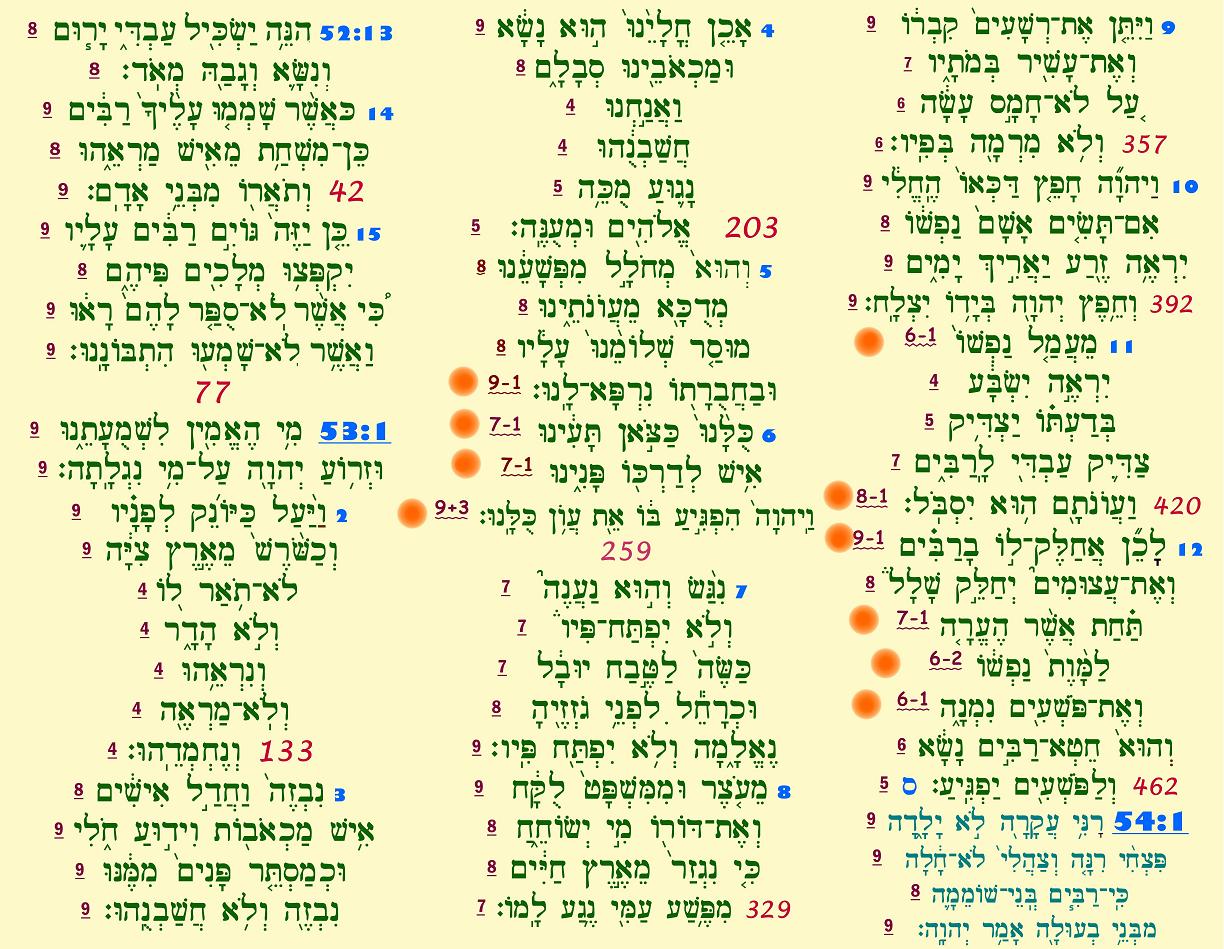
Palindromes emphasize what's between the bookends. I don't wholly know why it's done here. I do know you can prove it in Psalm 90 and Isaiah 53.
Methodology Notes
1. Noah's Flood Timing sets a precedence. I back into it from knowing the Mosaic calendar. So this is an educated guess about how God makes Flood timing, precendental. Conventional ancient Judaism believed Noah's birthday was the vernal equinox. Since the 57 days is stressed in Hebrew meter (especially Psalm 90's), Noah's birthday was Passover, instead. Jack Lewis' book on Genesis has information on manuscript variations and interpretations:
The 57 front and back denotes prepare for an ending. Mosaic law stresses that number, as does Hebrew meter, which is also used with Greek words in the New Testament (i.e., Ephesians 1:3-14). So here, preparation before going into the Ark, and preparation before disembarking. In Mosaic Law, the last 57 years of pre-Millennial history (after which begins the Day of the Lord) was depicted by Jubilee (for Harvesting the Gentiles), and Tribulation Strong implication that the Tribulation was to begin on a Nisan 1. I don't know if that intent remains, given how Church's 'Rapture' is unpredictable.
The 47 front and back denotes judgment testing followed by building or enduring. Signifies back up warning, for those who fail to prepare during the '57'. (It's not hard to imagine that during the 47 days, many still survived; some might have believed in God, moments before they died.) The 47 can play within the 57, or follow it. When playing 'within', it nests (i.e., first David crowned during the '57' ending the third 1050 from Adam's fall; Church Age inserted during the '57' after the Last David's death, preceding the fourth 1050 from Adam's fall).
Here, 7 year periods are often nested inside a 40, so it could play as 33 + 7 + 7 to reimburse the first seven. There are repeated examples; perhaps most relevant, is David's Rule paired with Solomon's 7 years' unrest following David's retirement (1 Kings 1-2). Earlier, Joseph's time (33 + 7 + 7 + 33 = 80, his years of rule, with the fat and lean 7s, in the middle). Christ was to live 40 years but died 7 years early, so the extra seven remaining 'played' between 64-70 AD, inside that back-ended '40'. The remaining 7, is the Tribulation. (The hasty writer of Hebrews seemed to expect the Tribulation to begin when the Temple was to go down, a foreknown thing since Israel delayed entering the Land for 40 years, and she was under siege when he wrote, in the Year of the Four Emperors. Paul also benchmarked it, in his meter of Ephesians 1:3-14.)
Trinity sevens seem to denote nested forays, hence building amidst attack or opposition. This is the second most-prominent number stressed in Psalm 90 (and in Ephesians 1:3-14). The 21's notably play in Israel's history. Three 7s for Jacob. Three sevens to build First Temple including Solomon's own building. (He delayed Temple dedication, 1 Kings 6 compared to 1 Kings 8 and companion passages in Chronicles — one wonders why.) Three sevens to build second Temple after returning to the Land (well-known opposition, see Haggai, Ezra, Nehemiah, Esther, etc).
Nexus mirrors converging on the selfsame day seem to denote the end of one epoch and beginning of the next. Jewish day begins in the evening (at sundown, technically), so Day 2 begins on Day 1. So here we have a '61' nexus, as it's Noah's Birthday, a solar-calendar anniversary 'keyed' with a lunar anniversary — well, 'lunar' in the sense of twelve 30-day months, the convention David adopted in 1 Chronicles 24. (So presumably the last 4-6 days were tacked onto Adar, no Adar Sheni needed. Israel followed Roman leap-year convention in Christ's day. So notice: 24 courses = 24 hours per day. Each priest has equal time of 365.25 hours if he carefully relieved his predecessor at the right hour.) But I don't know why God chose to use '61' as each 'bookend'. The number 60 is 30 doubled. 30 is a savior-age number (Joseph as vizier, David as King, Christ announcing Himself as Messiah). Beyond that, right now I don't know what importance for Israel / history, this nexus value, conveys.
2. Jewish modern accounting for a year is wrong. Refer to 'sarshalomin' videos:
Many other Jews know the modern calendar is wrong. Search on "Seder Olam Rabbah", a prophecy-accounting calendar; it cuts out years (i.e., under the Persians). Current Jewish calendar claiming 2011 = year 5771 of creation, seems based on the sor. By contrast, Mosaic law had 24 priestly courses. The last priestly course (Maaziah) could easily stay the extra days to intercalate; or, the hour of relief could be adjusted per course, so all priests serve equal time (365.25 hours). I would bet they did the latter. In which case, the course name (and hence relevant prophecy) in the chart's penultimate column, would change to the course for the following week. To keep this chart simple, I instead let the last course 'run' the extra five days.
3. It makes sense to start with Nisan. If we do, we get Biblically significant dates tying to Genesis 7, especially when you consider the metaphorical importance of Ark depicting salvation, water depicting Bible, being in Christ on the Cross (Romans 6), Temple Ark as an update on both Noah's ark and Moses' basket (when he floated to Pharaoh's daughter Hatshepsut).
4. All the deaths when Flood began, depict the later deaths of the firstborn of Egypt and other Exodus plagues, plus Passion Week, plus Pentecost, which is for 'harvesting the Gentiles'. The 10 plagues in Egypt also lasted about a year. The Flood people wouldn't have all have died immediately. They would swim, they would find debris and other things to cling onto, as the waters rose. Surely some of them jerry-rigged rafts. But the flooding stayed too high for too long. Lack of fresh water and food, exposure — would have eventually killed them. So both the Flood and the Exodus are the precedence for the Revelation plagues, and this precedence is intended — how else can Tribulation people be sure God is doing it, if they don't have a Book showing the same judgments happened before, in the same rollout fashion?
5. Flood lasts 365 days, when using the LXX's 57th day entry. Since 57 is such a prominent number in Hebrew meter; since Hebrew 'im' ending added to 'esher' would add the extra 10 days, it's not farfetched to assume scribal omission in Hebrew, retained in LXX. Same for 11th month, because the missing word has a run-on sound (ashte asar vs. asar). One can easily empathize with the surely tired, scribe.
6. Notice that in any event, the precedence is solar year, never lunar. Noah's birthday requires a solar-year accounting. So too, Israel's birthday, Exodus 12. Here, the mindless practice of one 'scholar' deferring to another, is most obvious. Oh, Israel uses a lunar calendar, the 'Church Fathers' assumed the Old Testament calendar was lunar, Dear Dr. So and So calculated Daniel 9 using lunar. Yeah: so we miss the extra seven years to alert all preterists to the fact the Tribulation, is yet future. We're so busy trying to be politically-correct, we stopped looking at the Bible.
Truthful scholarship is vital; so it's imperative to scholarly integrity, to stop parroting. It's okay to make mistakes, even for centuries; it's not okay, to cover them up. There's no basis for lunar-year accounting anywhere in Bible. Rather, as every scholar knows from the 'ancients', the Noahic calendar sets precedence for the Mosaic. But oh, the politics...
7. Of course, in the process we learn Noah's birthday. That will prove important for refining other Bible dates, i.e., Shem is born near the end of Noah's 500th year, so is a 501st day birthday present to Noah. In turn, Arpachshad is born just before Shem turns 101, so is a 101st day birthday present to Shem.
- So the extra two years is thus accounted, with Genesis 11:10 measuring from when the inundation (literal Hebrew) began.
- For the Hebrew of Genesis 11:10 says in the second year after the Inundation. Well, the second year begins, piggybacked on the anniversary of the first year. (On your first birthday, you are 'in' your second year.) So just after the Flood ended, still in 1656 (very near the end, probably), Arpachshad was born.
- So Shem's wife became pregnant while they were still in the boat. (So ignore the Noach portion of Midrash Rabbah on Genesis, claiming that sex was prohibited until Noah disembarked — what a farcical claim, given the import of procreation at that time).
- So the Flood really started in 1655 from Adam's fall, during the last six months. Here, 15 days into the last six months.
8. Dates shown might be + or - 1. Jewish day begins at sundown of the previous solar day. Also, the accounting might stress a beginning or an ending (or both), which thus requires adding or subtracting 1 or sometimes even 2. It depends on whether you are to count only one, or both endpoints. Context should alert you. It's not necessarily a rounding problem. Oftentimes Scripture 'counts' one more or one less, to stress that day or year.
Bible Meter Basics & 101
Correction: at 15:45 and following, I mistakenly said the 63rd syllable is at the end of Psalm 90:4. It's really Psalm 90:3, clever 'return' theme.
Ask any Jew what 'return' means: return to the land, special term. Which is, exactly what Israel was poised to do, when Moses wrote Psalm 90! Returning as God promised Abraham she would, in Genesis 12, Genesis 15, Genesis 17! Returning as Joseph made Israel promise when they'd bury him, to bring his sarcophagus, out of Egypt!
The 84 is the end count in Psalm 90:4, which theme is that the Day of the Lord is as a 1000 years, reference to the promised Millennium, which is yet future. So Moses ties Genesis 1 to it, to add to the reason why Israel exists. Not about, how old the earth is. Very different perspective.
Keeping it Simple: The Bible Meter is an easy way to memorize Bible that the ancients used. How do we know? By counting the syllables (ABCDEFG for them).
- Genesis 1 used in this video (screen stays static, keeping it simple for now: Genesis 1 Meter
- The 1050 structure in Genesis 1 meter is actually a pan-Bible structure, and all of the Bible dates use it as the hub. Time Map of these: GeneYrs.xls
- Also see Sanhedrin 97-99 in the Talmud. Online Talmuds are somewhat few, but my favorite is RabbinicTraditions.com: Legal Texts before 500 CE in Mishnah, Tosephta, Babylonian & Jerusalem Talmuds. It's searchable.
- Bible verses used to create it: FAQ Question #6a.
Simpler, short approach to understanding Bible Meter, which scholars have known existed, since the Reformation... but haven't figured out. This series goes slowly and uses English first; so it will be easier to grasp. You will be able to proof the interpetation, with real history. The purpose, is to see the face of God in the text, how much God loves you; but you can't see that, until you know text is timed for your benefit. What benefit? To protect you. To tell you how people in the world are thinking during your time, so you won't be fooled. So we start with Matthew 24:1 in any Bible you choose. You need the Greek, to know what time the words cover
Section of the Matthew 24 playlist which just focuses on Bible Meter 101 introduction. We go verse by verse in English so you can easily prove relevance & value. Best of all, you should be able to see the face of God 😍. Sorry about the voice; I have breast cancer & it spit into my throat. I'm on chemo, so my throat is getting gradually better. I'm still bedridden & blinded by cataracts, so I can't do this on PC, yet. Thank you for your patience!
Turns out Noah was born on Passover. I didn't learn that until May 28, 2011. The corrected timeline is still in draft form.
The LXX text has the right dates, but the Hebrew text has the wrong dates in four places (the Hebrew text needs corrections which can be uncovered by using the Poetic Meter itself of course). So that's why the Flood chronology in translation, doesn't balance. God foreknew that. Always, He preserves the right verse somewhere amidst the collections we have. God is Faithful.
Related Time Grant videos are in the Genesis series, beginning with Episode 8c1. These walk you through Adam's grant all the way through Christ's.
Anno Domini Meters + Bible has its own method of Anno Domini
Localised and edited source from the original threads on the old BibleWorks Forum: https://web.archive.org/web/20150911234754/http://www.bibleworks.com/forums/showthread.php?6133-Bible-has-its-own-method-of-ANNO-DOMINI-display.
[03-12-2015, 12:47 PM #1 | brainout | Join Date May 2004 | Posts 124]
Default Bible has its own method of ANNO DOMINI display
The Bible uses meter in the original language text to date its books and serve as A calendar countdown to Messiah and millennium, ever since Genesis. That's the theme of this post. The meter is based on a doctrine the Jews still recite in garbled form, that God assigns 2000 years to the goyim (really 2100) then 2000 to the Jews (really 2100) and then Messiah comes (and He did, born 4103 from Adam's Fall).
I've been working on this for seven years, and now have the confidence to state it categorically: whether in the Hebrew or the Greek, Bible has its own system for telling you when something happened and when any given book (or sometimes, even a particular chapter) is written. I call the latter, 'dateline meter', and its based on the writer 'sevening' the words (by syllable counts).
In the New Testament, the writers 'seven' to tell you their book dates, based on events in Christ's life. I've been making videos using the Greek pasted from BibleWorks' BGT, showing this live in the text. Sometimes the variants make a huge difference, and without the cntts embedded apparatus, I'd not know the vital differences.
For example, Paul has a penchant for dating his books based on Christ's Age at the time written, and since the Bible has two timelines for His Age — one based on Abrahamic deadlines and the other based on Davidic — Paul sometimes uses one timeline or the other. The Abrahamic deadline corresponds exactly with our 'AD', because Varro's calendar is three years overpadded (as Livy, Nepos and others complained at the time Augustus was considering which Roman AUC to adopt). So Paul neatly accomplishes the adjustment to Varronic dates, by using the Abrahamic timeline.
Upshot: every Bible book dates itself, as to when written. So all the arguing that's gone on for centuries can cease. Well, as soon as you see for yourself, how the Bible (Hebrew and now Greek) meter works.
I've now documented this meter in over 20 Bible books. Will finish documenting the dateline use of the meter pan-New Testament, in a few days. You can test all this live onscreen. I learned it all by accident, when analyzing Moeller's 'Great Isaiah Scroll', back in 2007.
This stuff is vital to textual criticism and hermeneutics. It's also just the bible, so there's no need for attribution, no credits or copyrights to observe. Just observe the methodology, and you can date any Bible book, yourself. Ergo all this disclosure. Not right, that I should keep it to myself.
I know there will be a lot of scoffing and skepticism. But anyone can count syllables. The system is very sophisticated, it's syntactical, and it goes back to Psalm 90.
[03-20-2015, 03:34 PM #2 | brainout | Join Date May 2004 | Posts 124]
Links to see the Anno Domini rhetorical styles in Bible for yourself
All using BibleWorks' own text, sometimes tweaked for variants (which are highlighted or stricken out, versus BGT, so the differences are obvious at a glance):
The only stuff which is copyrighted is the BibleWorks material; I didn't and won't copyright the research results. So you don't need to credit me. The point is to see the text and meter for yourself, as it's forensically provable. The talker doesn't matter. The text alone matters. And baby, all that hard work of the BibleWorks people and the centuries of painstaking copying... really pay off, as you'll see here. Life without BibleWorks is not worth living, because I'd never have this fast and clear a sight of Him, without it.
Most of the more conservative Bible book dates are thus validated. A few are radically different, i.e., Matthew datelines his gospel as 476 years after Nehemiah 6:15, 427 years after Malachi (using the syllable counts in Matthew 1), so 30 AD. Revelation is 88/9 AD, and the other Johannine books much earlier. Since the Church Fathers made up horrible lies against John, of course they misdate his books. I'd be surprised if any one of them ever once really saw him.
Preterism and Replacement Theology bite the dust, once you see these provable meters. Jewish Dispensationalism (as in Sanhedrin 97-99) receives some criticism, too, as they garbled the Psalm 90 count, else it's provably the version of Dispensationalism the Bible supports (which is simpler and tracked historically in Bible, versus what my fellow dispensationalists have been saying all along). Pre-Tribulation Rapture is an accounting necessity with two sevens left on Israel's clock when Christ dies (which scholars all miss, since they use lunar years to account the 62 weeks); so Church yes goes up at Rapture (event Revelation 4:1), and Bible since Moses tracked the time to when the Tribulation was supposed to begin. Church was not prophesied, and never replaces Israel. The Millennium is literal. All this you'll see in the meters, as they track time based on those doctrines.
Video shows how to use the worksheet to see God's Rules for Time; it is due to these rules that the Rapture exists, and is pre-Tribulation (a kind of Exodus Ascension for Church as Body of Christ). Note: I didn't know the Psalm 90, Daniel 9 and Ephesians 1 meter when I made the 8c series in 2008; so the videos don't talk about that added Bible proof. These videos were originally posted, September 3, 2008. Video description 8ab is pasted below:
The Lord of All is the Lord of Time. In the Angelic Trial, which was introduced in Genesis 1:2, the Lord makes a Trial of Mankind to prove to Satan & Co., why their sentence is just. Part of that Trial is the Trial of Time Continuing. Believers are made to buy time — a bigger work than any human can do, obviously — if they vote to be super-matured by God. You vote, by learning and living on Bible. That's the history God plots in the Bible. Not what you do with your dead-in-Adam body, but what you believe and learn about God. That's the whole theme of the Trial, Hebrews 11:1.
In short, you are enabled By God to Buy Time for the Human Race. With Time, go the other accoutrements. Christ wasn't kidding when He said, 'seek ye first the kingdom of God and all these things will be added unto you'. Yeah, the believer is to be a 'spiritual atlas', as my pastor once put it. Learn and live on Bible and that's what God will do to you and for the world! Better than money in a collection plate, huh...
This 'Buying Time' accounting begins in Genesis 5, which is here introduced. We'll see how the 'all the days of your life' clauses in Bible do not necessarily mean from birth forward, so do not mean from Adam's creation, forward. Thus again we know that Genesis 1:2 is about Earth's Restoration, and doesn't even measure Time until Adam's fall.
The Genesis 5 roster and God's Rules for Time are the focus of Episode 8. You'll learn how to use the Excel worksheet I wrote to display this doctrine about Time, and you can vet it in the Bible.
Sorry this is so complex, but I've been working on it 15 years, trying to understand the 'salt' doctrine, which in my (now dead) pastor's words was called 'believers are used by God to buy time'. How? I wondered, so asked God where in Bible to find the proof, starting in year 2000. Well, now I know and all this post shows you where you can see it in Bible for yourself, too. Use 1 John 1:9 as you study it, else you're wasting your time. I sure did, when I forgot to use it.
Whole sections are devoted to some of the Bible books, because the meters all ape Psalm 90, Isaiah 53 and Daniel 9's meter:
Each Old Testament book like each New Testament book, is metered at its beginning. I've not had time to do the rest. Of particular importance will be Genesis 1 and Genesis 49 (yes, important chapters have their own dateline and other meters).
- Matthew is provably the first Gospel. Synoptics shows how Luke 'wraps' his text to Matthew, and then Mark 'wraps' to Luke and Matthew, so those claiming 'quelle' or Mark as first Gospel, are obviously wrong. Can prove that, even from translation. So the meters are just adjunctive to proving which Gospel is really first. However, the meters are quite precise.
- Then the first one to meter a 1000-year long recap of the prophecy of Messiah fulfilled, balancing for Abraham's too-early super-maturation (who matured 2046 from Adam's fall, 53.5 years in advance of the 1050 + 1050 deadline from Adam's fall), was Mary in her Magnificat.
- Next books were Galatians through Romans.
- Luke wrote next, codifying the Magnificat, building his entire Gospel outline around Magnificat. In the same year, when Paul first imprisoned, both Luke and Ephesians came out. Paul's Ephesians piggybacked on Mary piggybacking on Daniel, to form a 434 (plus her 56) added timeline to complete time prophetically to Odovacer to show Church 'salt' trend (negatively). Actual timeline in Ephesians, syllable=year AD charting the emperors, so much so that each second "η" in each θελήματος was reserved for an Emperor whose 'will' (get the pun) got undone by his successor (Trajan then Macrinus then Diocletian).
- James wrote last in the same year, and his second dateline is also patterned on Luke, specifically on Zecharias' speech.
- Then came the prison epistles ending with Philemon.
- Then came Acts, when Paul got out of jail in 62 AD.
- Then came the post-prison epistles 1 Timothy, Titus and finally 2 Timothy. Titus is with the other Pauline material.
- Next, Paul dies probably March 68 AD as a result of Vindex courting rebellion (can't yet prove it wholly, but the hypothesis is plausible), so Peter writes to Paul's old stomping ground, adding to the prophecy content about Church in 1 and 2 Peter, creating a marching song from the Ephesians text.
- Then Peter dies, and Jude comes in, adds a 'stanza' to the marching song.
- Then comes Mark; and Hebrews, published within 9 months of each other; given the meter, maybe written by Luke and Mark. Hebrews uses Mark's order of points in his Gospel to craft the Hebrews' outline.
- Then Temple goes down; 7 years after, John writes his Gospel; then 3 years later, 1 John; then 8-9 years later, Revelation.
This is all provable. Just parse the text into clauses, then count the syllables per clause; then aggregate them in another column, as you'll see me do in the docs and videos (which means you can catch me where I've screwed up, ha). First and second time the aggregated syllables 'seven', are the book's datelines. Any more sevening after that, creates a prophecy of some kind, a concordance tag to another Bible passage, etc. However, from Acts forward there is a more complex dating formula which uses the values in each clause to construct an elaborate doctrinal precis of the date. John uses this style exclusively. The 'normal' Old Testament style was to just seven twice, and then you measured back and forward from each dateline to get your Time GPS. You'll see it yourself when you parse any Bible book start or important chapter.
The commonality of formulas and tags is distinctive, so identifiable as to what Bible book and where in it, the tag intends you to look. Dateline tags are usually in years-from
Christ should have been born under the Abrahamic timeline (2046 + 2100 limit of Time - 40 allotment for His Life, 4106 is the BC/AD converter Bible uses); or, when He was actually born, 4103 after Adam's fall (using only Bible, not a "church father", Ussher, or other guy who didn't only use Bible and only solar years to do his tally). That year, was 1000 years after David crowned at Hebron in 1010 BC. So it's three years earlier than the original schedule, because David was crowned seven years' late over all Israel (2 Samuel 5-7). David dies at age 77 (big scholar mistake to misread 1 Kings 6:1 which plainly says David had been dead 3.5 years when the Temple construction started). So the new outer limit of time became 4143 not 4146 (1000 years after David died), and that is the limit of the 62 weeks in Daniel, too (586 BC - 70 = 516 BC - 70 = 446 BC Nehemiah's visit - 49 years then = - 434 = 37 AD = 4143 from Adam's Fall). Because, the Temple had a 490-year time grant which at its demise, still had 126 years remaining, as Isaiah 53 had charted. So part of the '70 weeks' is reimbursement on 'unpaid' Temple Time, and the Tribulation = 7 of those years. The 62 weeks reimburses for the 364 years Temple stood, too, plus another 70 years (video shows that). Very obvious accounting.
- When He reached Roman age of manhood (to play Psalm 90:15 equidistance game with 15th year of Tiberius)
- When He went out into the wilderness at age 29 (same as the toga virilis),
- When He should have died under the Abrahamic schedule (4146),
- the Davidic Schedule (4143), and
- when He really died (4136, the 61st week, not 62nd).
- Forward, datelines are phrased in terms of years to the Tribulation (4194 start), the Millennium (4201 start), or some subset (like the payback for Abraham's credit, a favorite with the New Testament writers).
- Additionally, there are four fiscal years to reconcile: autumnal (Rosh HaShanah), vernal (Nisan, Exodus 12), Roman (calendar), and His Own 25 Chislev aka Chanukah AKA 1st day of Saturnalia birthday (a joke Paul makes in Galatians 4:4 using Chronos AKA Saturn, prophecy in Haggai 2 which Mary quotes). So when the writer switches fiscals, he generally subtracts or adds a year to his tally; you thus know more precisely, when he writes.
- Everyone was counting the 40 years after His Death, to the demise of the Temple.
- Datelines back to significant events in Israel's history (including important Roman dates) help provide a secular GPS of 'where we are on the Time Map'.
All of these formulas were used since Moses, but were back then, 'years to Messiah and Tribulation and Millennium related'. Post Cross, they are Anno Domini values, as you'll see in the docs and videos. Ultimate proof that the Infallible and Inerrant Word Was Preserved, despite all the (usually picayune) copying errors. Pray for folks like KVJ-Only and Bart Ehrman who can't count syllables, so mistake the Bible as corrupt. Man, what they are missing! If I die tonight, I will be content. Absent BibleWorks, I'd never know this stuff, and would have far less certitude about Bible meaning.
[03-28-2015, 12:13 PM #3 | brainout | Join Date May 2004 | Posts 124]
More updated meters
I just posted a starter video on Genesis 1 meters. It will likely run 1050, but I'm in the middle of doing it and don't yet know for sure, what's the ending count (am up to 707 for the fifth day: each feh marker sevens the paragraph, so it's easy but a pistol to paste in Word). The doc only goes through Day 2 (second feh marker). Will take awhile to do the whole thing, as it's the precedent for all Bible meters. I knew that long ago, but never parsed it until now. You can do it yourself, of course, once you see the style.
Turns out Ephesians also uses adamic years which match the worksheet (thank God I don't have to redo it yet) just like the other New Testament books all do, but specifically uses the same formulae as Romans. The videos go through the boring methodology, so you can see how it got done. Again, you can just use the meter webpages and bypass the videos entirely. (I only do the videos to explain the docs.)
Pauline Anaphora Timeline Update (PATU)
PATU is now somewhat outdated. Its focus was to discern Paul's Anno Domini conversions. Turns out all NT books use ADAMIC years and the Lord's AGE as their datelines. See Bible Dateline Meters for more info. Latest thread is at: frankforum/viewtopic.php?f=15&t=532&p=2356#p2356
Genesis 1 Meter
Psalm 90 Meter
- Psalm 90:1-17 BHS Text, parsed Meter +Metered English Translation
- God's Play of History: Psalm 90, Isaiah 53, Daniel 9 and Eph1:3-14
- Judges.xls
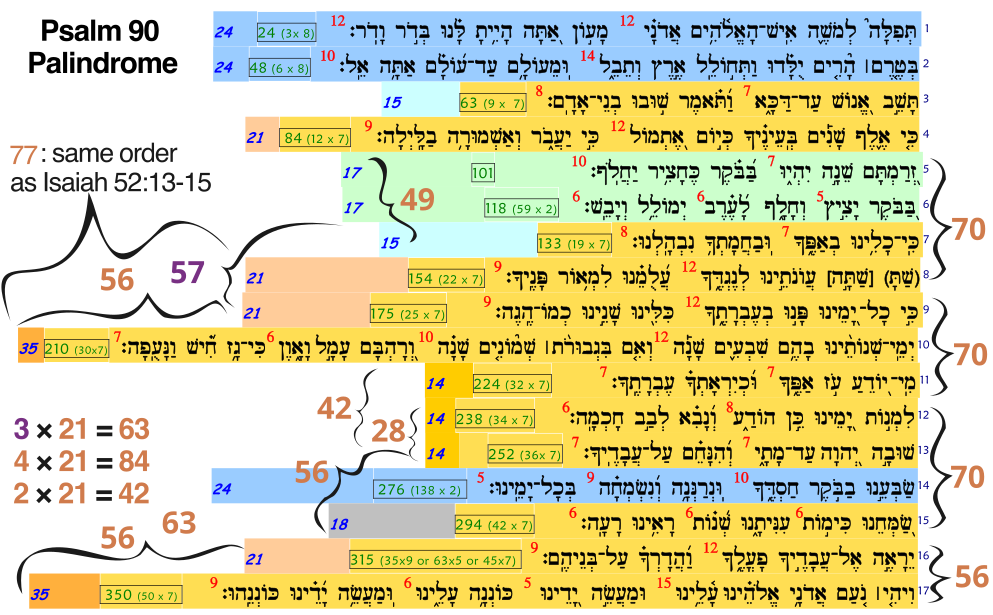
Matthew 24 Meter
- Matthew 24 Meter Forum Thread
- Matthew 24-25 Prophecy of Christian Impact on World During Church Age
- Luke 21:5-36 Meter (prophecy of West's future, meter wraps to Eph1:3-14)
IMPORTANT CORRECTION: When I talk about 1960, I mention Falwell. He wasn't the focus of that year, but rather Billy Graham, who GETS THE GOSPEL WRONG and switches to a social gospel, as far back as 1958, Billy Graham Classic Crusade - The Cross (1958)
1959, he visits RUSSIA for the first time and wants to spread his false gospel THERE. So then does, over the next several decades. THAT is the tie Bible develops, IN ADDITION to the politicizing that Falwell would come to specialize in, and yes starting with Nixon. But GRAHAM was there in 1975 when Francis Schaeffer came up with his false vision of #SevenMountains, and GRAHAM was his friend then. Both his and Schaeffer's sons were pals (q.v., the God in America link in commentsw below).
The #TrumpRussia connection begins way back in the 1960s. A guy on Twitter has been tracing it, replete with legal records he pays to get (so donate to him, if you're inclined): https://twitter.com/patrickLSimpson/status/977974360517509120 (account has since been terminated)
I didn't know ANY of this when making the video here. So that means the full scope of the meaning is not yet presented. SORRY!
PBS did a series called God in America which (unknowingly) helps elucidate what the Bible is saying, here. https://www.pbs.org/godinamerica/view/
Its final two parts (final episode, really, 2 hours) focuses on the time period in Matt25:10, and places Falwell's activism starting AFTER the Seven Mountains vision of Schaeffer, Bright, Cunningham (that vision isn't mentioned in the film), spurred onto it by Schaeffer. So that conflicts with what I said, which is based on other reports. Maybe the film is more correct, in which case that 1975 vision IS KEY to the whole denouement we see today.
LAST HOUR ESPECIALLY PROVES THAT THE ABORTION THINGY WAS TRUMPED UP TO GET VOTES, that evangelicals WERE NOT INTERESTED IN THE ABORTION ISSUE post Roe v Wade UNTIL SCHAEFFER'S SON CONVINCED HIS DAD TO CONVINCE JERRY FALWELL TO CALL IT MURDER. Till then, Falwell only wanted to preach Bible.
THE WHOLE ABORTION PROLIFE THINGY IS A SCAM FROM THE GETGO.
IMPORTANT: when I did this video, I did not yet know how vast and worldwide the connections are. I didn't know the RUSSIAN connection of ThirdRome (a plan to take over the world, Russia's own self-image since 1500s), nor much of the RECONSTRUCTIONIST movement beginning in late 1950s (which this video covers but without mentioning them). My pastor was (back then) screaming against those people, but I didn't think to connect them when making this video. They are a morphing from Replacement Theology, VERY VERY anti-semitic, and SevenMountains is an update on Reconstructionism, which is an update on Replacement Theology (which has been around since Irenaeus, Tertullian, Origen). VILE EVIL that gave birth to CONSTANTINE'S ROME in CONSTANTINOPLE, the ROME of Revelation 17.
But I know now, as of this writing. Amazing how learning this prophetical timeline can unveil so much that's hiding in plain sight to prove yeah, the interp is accurate. Whew. Still vetting, tho.
See: Dominionism Rising: A Theocratic Movement Hiding in Plain Sight
ERRATUM: at 54:20 or so I mistakenly said Messiah had to be born 1000 years after David died. I meant Messiah had to DIE by then; it's the outer limit of time in Daniel 9:26, but scholars miss it, because they mistakenly use lunar years when counting Dan 9's years, and they mistakenly use Josephus rather than 1Kings 6:1, to know David died age 77 not age 70.
So look how convenient: if you used solar years as Bible always does, you'd realize the timeline is SEVEN YEARS LONGER (yeah, because David died seven years later). So their two errors self-cancel, and for centuries they don't catch on. Never mind, they also then can't get the whole Bible timeline right from David onward, for the same reason, and still argue over it today.
ERRATUM: at 42:50 I mistakenly said 1960-2041 was 40 years. I meant 1960-2001, but it depends on the fiscal used, as to HOW it's 40 rather than 41. But that's still the point of the period, and it still seems to be analogous to the 80-year rule of Joseph, but I have to analyze that idea more, lest it be a mere time-period coincidence.
How Satan Deploys Islam, playlist mentioned at 46:32 and following, https://www.youtube.com/watch?v=Uk-MIH7IvTg&list=PL90D90E03E31E6D55&index=7
At 33:17, I mentioned the Trump blasphemy in a video of his Liberty U speech. Here's that video, and you only have to listen to the first min to hear him REPLACE the Holy Spirit, who in 2Cor3:17 which Trump quotes, is the One protecting your liberty. But DT says HE will do it, instead! God thus advertises Himself as #NeverTrump.
Video: Donald Trump: "Two Corinthians..." (C-SPAN)
I decided to put the 30 characteristics (at 5:10 in video) here: BibleHebMeterCharacs.htm. So now you can take any passage in Bible and test it, in the original mss. Won't work with translations.
The Greek syntax of Matt25:10 tells you what happened, so I translated it live which your own translation will largely confirm. Basically, the apostates then left Christ for politics, illustrated by Falwell senior, Robertson, all the jerk TBN types today. It was THE phenomenon of the 1960s to counter the Dems playing the race card, so you shouldn't have trouble confirming the meaning.
So by 1998, end of Matt25:10b, Christ had arrived (through good advanced Bible teaching, more ms discoveries, etc. — the interim meaning of a prophecy later to be fulfilled literally) and shut the door with those wanting to learn Him rather than politics. In short, that's how long it took for the polarization of wise vs. foolish to occur (trend since 1703 AD when Chapter opens).
You can prove that too, by the wild pulpit changes in the foolish agitating for politics as if it were spiritual, especially the vile prolife crowd. My own pastor, not knowing this meter, went around the country in 1998 warning of this shift, wondering if the US had only 40 years left cuz we'd gone so saltless (violating John 18:36). Which is ironic, as in the older 1960s he too had been caught up in the politics, you can hear him rant in the early classes while exegeting the Greek/Hebrew (he daily taught Bible line by line in the original ms, that's why I can read Bible in Hebrew/Greek).
But all this is just hearsay to you. Better to use 1Jn1:9 and ask God to show you proof as you need to see it. The most important goal of this process is the bi-directional interplay of learning and living on Bible and getting feedback from the Holy Spirit. It's very academic and fulfilling. So do that, see what happens.
Luke's Meter
- Luke's Meter Forum Thread
- Luke Dateline Meters
- Luke 21:5-36 Meter (prophecy of West's future, meter wraps to Eph1:3-14)
Correction: at 1 min, I misstated the 84-year old as Elizabeth. It was Anna, in Luke 1. The AGE has long perplexed scholars, why mention it. Well, it's because Luke's Gospel outline tracks to Mary's Magnificat meter, since in effect that was the first 'book' of the Bible, hers and Zecharias speeches predated Matthew's Gospel by 35 years. So people had memorized those syllable counts, already. Both of those speeches are covered in Magnificat Meter of Time , replete with pdfs you can download to see the Greek meter (and vet it), yourself.
CORRECTION at 30 minutes, where I talk about 469, I make a math error, only adding 20. It's really 30, so is 499 AD.
🤣 at about 26 mins into the video, where I talk about Luke 21:9 meaning 219 AD (189 syllable count plus 30 for when Christ died), with 126 as the interval since last sevening, I didn't CALCULATE what the equidistant 126 (aping Isaiah 53's style) added up to. It's 343, same as PAUL's Eph 1:12 benchmark for Constantine debacle! So Luke IS IS IS tying to Paul!
Think about that parallel: Luke 21:9 is about wars and rumors of wars. Yeah, and it was: that was the prelude for the 'Crisis of the Third Century' (Roman historian term, google it). What kicked it off.
Moreover, 126 years later, 343 AD, Constintine's brutal sons are tearing the Roman empire apart over whether 'God' is One or Three!
Daniel 9 Meter
- Daniel 9 Meter Forum Thread
- Daniel 9:4-19, Hebrew with Meter Parsing and Notes
- Daniel 9:24-25 Meter Parsing
- God's Play of History: Psalm 90, Isaiah 53, Daniel 9 and Eph1:3-14
- Temple started 3.5 years late (forum thread)
Meter often certifies doctrines we already knew; but its most surprising function is to 'track' Pre-Tribulation Rapture. All New Testament meter plays on Daniel 9:24-27. Daniel 9:4-19, and 24-27, are metered; so too Isaiah 1:1, Chapter 53 and Psalm 90. The passages 'tag' each other by meter as cross-reference concordance. The most frequent 'tag' is syllable 133, tagging Psalm 90:7 and Isaiah 53:2. Bible writers just mentioned (and Mary plus Zecharias), tag those passages so the reader can match CONTENT to whatever the later writer/speaker means to say.
To grasp Daniel 9, you must know his meter; it's based on Isaiah 53's. God ALSO uses Isaiah 53's meter in Daniel 9:24-27, to reaffirm Timeline for Temple reconstruction. For Isaiah tells it first, in 712BC. His meter reminded Jewish believers of that future, just as you'd use a calendar, by SYLLABLE COUNTS. For Jews already had to count them, to test memorization and copying. God thus needn't but parse the timeline, in His Reply via Gavriel; so Daniel isn't surprised and asks no questions. To us in English, Daniel 9's numbers jump from nowhere, so we don't know WHY those numbers. But in Hebrew and New Testament Greek, it's referenced all over: for Temple depicts Messiah.
It's a genre: TIME meters syntactically divisible by 7. Meter interacts with text (as in Daniel 9). 1 consonantal sound + 1 vowel sound = 1 syllable = 1 year. No additions; subtract only for elision. Time is accounted backward then forward full-circle from Adam's Fall to a scheduled (pre-Church) Millennium, had Israel accepted Christ. Since she didn't, New Testament meters stop @62nd week (Ephesians 1:3-14 = 434 syllables).
Peter Meter
- 1 Peter 1:1-12 Meter
- 2 Peter 1:1-4 Dateline Meter
- Peter's Christian Soldier Marching Song (Interleaved with Ephesians 1:3-14), with Metered Translation
Hebrews Dateline Meter
2 Samuel Meter
James' Meter
Acts Dateline
Mark 13 Meter + Mark's Gospel Proves Q Scholars Wrong
- Mark 13 Meter Forum Thread
- Mark 13 Meter (prophecy of Byzantine Empire)
- Mark's Revised Dateline Meter
Jude Meter
Pauline Date Meters
- 1 Thess 1:1-5 Dateline Meter
- 2 Thess 1:1-5 Dateline Meter
- Romans 1:1-7 Dateline Meter
- 1 Corinthians 1:1-3 Dateline Meter
- 2 Corinthians 1:1-3 Dateline Meter
- Ephesians 1:3-14, Paul's Meter of Church Time
John's Gospel Dateline Meter Variants
Isaiah 53 Meter
- Isaiah 53 Meter
- God's Play of History: Psalm 90, Isaiah 53, Daniel 9 and Ephesians 1:3-14
- Outdated: Isaiah 52:13-54:1, Working, Expanded, and Poetic Translations, w/ Exegetical Notes +videos on Psalm 90's Hebrew Meter and keywords
- Outdated: Isaiah 53:10-12: BHS/LXX Amalgamated Translation w/ Exegetical Notes
February 2011 update: I've reversed my contention that Hebrew text is missing from Isaiah 53. By Isaiah's Hebrew meter pattern, you can prove that no text is missing. You can also prove it, I just learned, by examining the interplay between Psalm 90 and Isaiah 53, Daniel 9's prayer and of all things, Ephesians 1:3-14's Greek!
Videos don't display well. So you may need to download some of their JPG pictures. Updated vector to show the stages of initial manual parsing of the chapter which isn't clear in the Isaiah 53 Meter Key video:
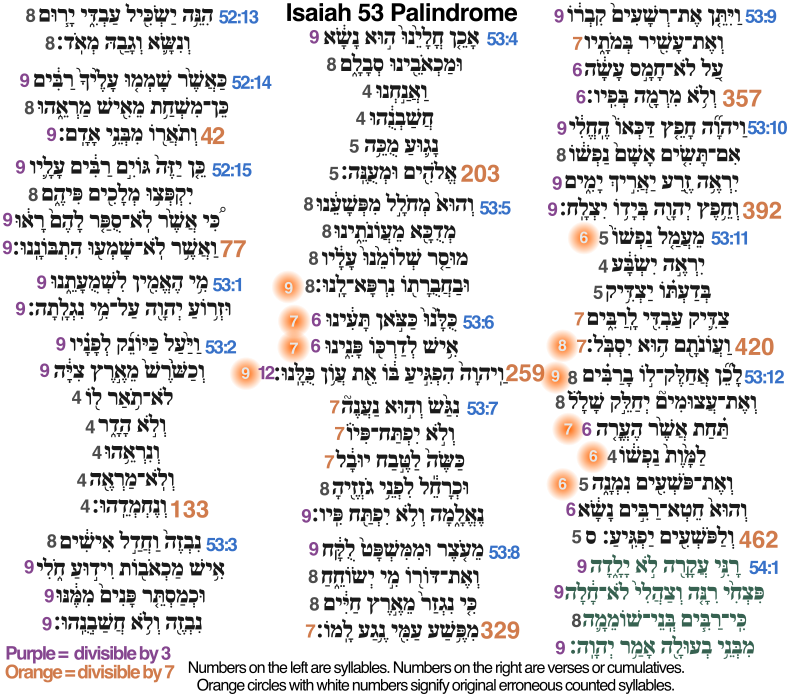
(Yapping Most High): Jewish dispensationalism compared with God's 1050-year 'house' of Time, primer videos. Since at least Rambam (Maimonides), Jewish Dispensationalism claims God Orchestrates Time to run in 2000-year units. That's close to the Biblical description. (Really 2100 years for the goyim; 2100 years for the Jews; and then Messiah was supposed to Come, which He did.) Since their calendar is off, Jews expect Messiah to arrive in their Year 6000, but their calendar is 346 years short of history, and many Jews know that. (Year 2011 they call Year 5771, but it's really the 6117th year from Adam's Fall. Sometime during the Hasmonean period, or at least by Josephus' day, someone took the Seder Olam Rabbah and made it into a historical calendar, even though everyone knew the makers of the SOB had cut out years, like those under the Persian kings. For the SOB was designed to keep track of Promise Time, which they didn't reckon as consecutive time. You can research this cutting-out, on the internet.)
Philemon Meter
Titus Meter
Revelation 17
- Revelation 17 Meter Forum Thread
- Revelation 17:1-18 Meter (prophecy of Rise of Gentile Anti-Christ as Fake Church)
- John's Revelation 'Map'
Four Emperors
Three-Way Hebrew Converter
Paleo-Hebrew:
Proto-Sinaitic:
Hieroglyphs:
This converts Hebrew simultaneously into: Paleo-Hebrew, Proto-Sinaitic, and the closest Egyptian hieroglyphs that they were originally based on. As far as I'm aware, this is the only utility on the internet of its kind to properly render Hebrew in all three alphabets at once. Because there is no Unicode for Proto-Sinaitic I'm using a custom embedded CC0 font.
Warning: while this converter can output left-to-right or right-to-left hieroglyphs, the Unicode glyphs themselves are using left-to-right logic (a limitation I have no control over), so you will either need CSS or your word processor to arrange the left-to-right hieroglyphs as right-to-left. Using the right-to-left output simply simulates right-to-left by reordering the words but this won't be suitable for long paragraphs.
An example of what I mean with the hieroglyphs, and a snippet of Genesis 1:1-5 in the Hebrew for comparison:
Per-word-basis RTL hieroglyphs operating on LTR (incorrect):
𓊋 𓆟𓈇𓃾 𓈖𓌉𓂝 𓁶𓃻𓉐־𓂝𓀠𓂝𓌉 𓉐𓁶𓁹־𓂝𓀠𓂝𓌉 𓀠𓋿𓂝𓋿 𓃾𓁶𓃻 𓂧𓌔𓈇𓋿𓌉 𓈖𓌉𓂝 𓁶𓌉𓃾𓋿 𓈖𓂝𓀠𓋿𓃾 𓃾𓁶𓃻𓂝𓌉 5 𓂧𓌔𓈇𓀠 𓆓𓂝𓉐𓌉 𓁶𓌉𓃾𓀠 𓆓𓂝𓉐 𓈖𓂝𓀠𓋿𓃾 𓋿𓆟𓉐𓂝𓌉 𓉐𓌉𓄤־𓂝𓂧 𓁶𓌉𓃾𓀠־𓏴𓃾 𓈖𓂝𓀠𓋿𓃾 𓃾𓁶𓂝𓌉 4 𓁶𓌉𓃾־𓂝𓀠𓂝𓌉 𓁶𓌉𓃾 𓂝𓀠𓂝 𓈖𓂝𓀠𓋿𓃾 𓁶𓈖𓃾𓂝𓌉 3 𓈖𓂝𓈖𓀠 𓂝𓆓𓊋־𓋿𓁹 𓏴𓊋𓈇𓁶𓈖 𓈖𓂝𓀠𓋿𓃾 𓈇𓌉𓁶𓌉 𓈖𓌉𓀠𓏴 𓂝𓆓𓊋־𓋿𓁹 𓂧𓌔𓈇𓌉 𓌉𓀠𓉐𓌉 𓌉𓀠𓏴 𓀠𓏴𓂝𓀠 𓇑𓁶𓃾𓀠𓌉 2 𓇑𓁶𓃾𓀠 𓏴𓃾𓌉 𓈖𓂝𓈖𓌔𓀠 𓏴𓃾 𓈖𓂝𓀠𓋿𓃾 𓃾𓁶𓉐 𓏴𓂝𓌔𓃾𓁶𓉐 1:1 Genesis
LTR hieroglyphs without RTL CSS applied (incorrect):
Genesis 1:1 𓉐𓁶𓃾𓌔𓂝𓏴 𓉐𓁶𓃾 𓃾𓋿𓀠𓂝𓈖 𓃾𓏴 𓀠𓌔𓈖𓂝𓈖 𓌉𓃾𓏴 𓀠𓃾𓁶𓇑 2 𓌉𓀠𓃾𓁶𓇑 𓀠𓂝𓏴𓀠 𓏴𓀠𓌉 𓌉𓉐𓀠𓌉 𓌉𓈇𓌔𓂧 𓁹𓋿־𓊋𓆓𓂝 𓏴𓀠𓌉𓈖 𓌉𓁶𓌉𓈇 𓃾𓋿𓀠𓂝𓈖 𓈖𓁶𓈇𓊋𓏴 𓁹𓋿־𓊋𓆓𓂝 𓀠𓈖𓂝𓈖 3 𓌉𓂝𓃾𓈖𓁶 𓃾𓋿𓀠𓂝𓈖 𓂝𓀠𓂝 𓃾𓌉𓁶 𓌉𓂝𓀠𓂝־𓃾𓌉𓁶 4 𓌉𓂝𓁶𓃾 𓃾𓋿𓀠𓂝𓈖 𓃾𓏴־𓀠𓃾𓌉𓁶 𓂧𓂝־𓄤𓌉𓉐 𓌉𓂝𓉐𓆟𓋿 𓃾𓋿𓀠𓂝𓈖 𓉐𓂝𓆓 𓀠𓃾𓌉𓁶 𓌉𓉐𓂝𓆓 𓀠𓈇𓌔𓂧 5 𓌉𓂝𓃻𓁶𓃾 𓃾𓋿𓀠𓂝𓈖 𓋿𓃾𓌉𓁶 𓂝𓌉𓈖 𓌉𓋿𓈇𓌔𓂧 𓃻𓁶𓃾 𓋿𓂝𓋿𓀠 𓌉𓂝𓀠𓂝־𓁹𓁶𓉐 𓌉𓂝𓀠𓂝־𓉐𓃻𓁶 𓂝𓌉𓈖 𓃾𓈇𓆟 𓊋
LTR hieroglyphs with RTL CSS applied (correct):
Genesis 1:1 𓉐𓁶𓃾𓌔𓂝𓏴 𓉐𓁶𓃾 𓃾𓋿𓀠𓂝𓈖 𓃾𓏴 𓀠𓌔𓈖𓂝𓈖 𓌉𓃾𓏴 𓀠𓃾𓁶𓇑 2 𓌉𓀠𓃾𓁶𓇑 𓀠𓂝𓏴𓀠 𓏴𓀠𓌉 𓌉𓉐𓀠𓌉 𓌉𓈇𓌔𓂧 𓁹𓋿־𓊋𓆓𓂝 𓏴𓀠𓌉𓈖 𓌉𓁶𓌉𓈇 𓃾𓋿𓀠𓂝𓈖 𓈖𓁶𓈇𓊋𓏴 𓁹𓋿־𓊋𓆓𓂝 𓀠𓈖𓂝𓈖 3 𓌉𓂝𓃾𓈖𓁶 𓃾𓋿𓀠𓂝𓈖 𓂝𓀠𓂝 𓃾𓌉𓁶 𓌉𓂝𓀠𓂝־𓃾𓌉𓁶 4 𓌉𓂝𓁶𓃾 𓃾𓋿𓀠𓂝𓈖 𓃾𓏴־𓀠𓃾𓌉𓁶 𓂧𓂝־𓄤𓌉𓉐 𓌉𓂝𓉐𓆟𓋿 𓃾𓋿𓀠𓂝𓈖 𓉐𓂝𓆓 𓀠𓃾𓌉𓁶 𓌉𓉐𓂝𓆓 𓀠𓈇𓌔𓂧 5 𓌉𓂝𓃻𓁶𓃾 𓃾𓋿𓀠𓂝𓈖 𓋿𓃾𓌉𓁶 𓂝𓌉𓈖 𓌉𓋿𓈇𓌔𓂧 𓃻𓁶𓃾 𓋿𓂝𓋿𓀠 𓌉𓂝𓀠𓂝־𓁹𓁶𓉐 𓌉𓂝𓀠𓂝־𓉐𓃻𓁶 𓂝𓌉𓈖 𓃾𓈇𓆟 𓊋
Original Hebrew:
Genesis 1:1 בְּרֵאשִׁ֖ית בָּרָ֣א אֱלֹהִ֑ים אֵ֥ת הַשָּׁמַ֖יִם וְאֵ֥ת הָאָֽרֶץ׃ 2 וְהָאָ֗רֶץ הָיְתָ֥ה תֹ֙הוּ֙ וָבֹ֔הוּ וְחֹ֖שֶׁךְ עַל־פְּנֵ֣י תְה֑וֹם וְר֣וּחַ אֱלֹהִ֔ים מְרַחֶ֖פֶת עַל־פְּנֵ֥י הַמָּֽיִם׃ 3 וַיֹּ֥אמֶר אֱלֹהִ֖ים יְהִ֣י א֑וֹר וַֽיְהִי־אֽוֹר׃ 4 וַיַּ֧רְא אֱלֹהִ֛ים אֶת־הָא֖וֹר כִּי־ט֑וֹב וַיַּבְדֵּ֣ל אֱלֹהִ֔ים בֵּ֥ין הָא֖וֹר וּבֵ֥ין הַחֹֽשֶׁךְ׃ 5 וַיִּקְרָ֙א אֱלֹהִ֤ים׀ לָאוֹר֙ י֔וֹם וְלַחֹ֖שֶׁךְ קָ֣רָא לָ֑יְלָה וַֽיְהִי־עֶ֥רֶב וַֽיְהִי־בֹ֖קֶר י֥וֹם אֶחָֽד׃ פ
Glyph Conversion Chart (V1.3)
| Description | Ashuri | Paleo-Hebrew | Proto-Sinaitic | Egyptian (Primary) | Egyptian (Secondary) |
|---|---|---|---|---|---|
| Aleph: ox, offering | א | 𐤀 | א | 𓃾 | |
| Beth: house, shelter | ב | 𐤁 | ב | 𓉐 | 𓉔 |
| Gimel: throwing stick, create | ג | 𐤂 | ג | 𓌙 | 𓌚 |
| Dalet: fish, introduce, open | ד | 𐤃 | ד | 𓆟 | 𓉿 |
| Heh: man, rejoice, worship | ה | 𐤄 | ה | 𓀠 | |
| Waw: mace, damage, bright, white, command, decree, subjects | ו | 𐤅 | ו | 𓌉 | 𓎗, 𓅚 |
| Zayin: die, sword, duality | ז | 𐤆 | ז | 𓏱 | 𓏭, 𓍡 |
| Heth: (irrigation) canals, connecting, fence, threading | ח | 𐤇 | ח | 𓈇 | 𓈈, 𓎛, 𓊐 |
| Teth: beauty, good | ט | 𐤈 | ט | 𓄤 | |
| Yodh: hand, raise, lift | י | 𐤉 | י | 𓂝 | 𓍟, 𓍞 |
| Kaph: palm | ך - כ | 𐤊 | כ | 𓂧 | |
| Lamedh: crook, flock, rule, authority | ל | 𐤋 | ל | 𓋿 | 𓋾 |
| Mem: water | ם - מ | 𐤌 | מ | 𓈖 | |
| Nun: cobra, snake | ן - נ | 𐤍 | נ | 𓆓 | |
| Samekh: column, support, stability | ס | 𐤎 | ס | 𓊽 | |
| Ayin: eye, 'to do', make | ע | 𐤏 | ע | 𓁹 | |
| Pe: corner, court, occupations, magistrates, mouth | ף - פ | 𐤐 | פ | 𓊋 | 𓀅, 𓂋 |
| Tsade: plant, germination | ץ - צ | 𐤑 | צ | 𓇑 | |
| Kuf: baboon, monkey, cryptography, furious | ק | 𐤒 | ק | 𓃻 | 𓃷 |
| Resh: head, first, chief | ר | 𐤓 | ר | 𓁶 | 𓂉 |
| Shin: composite bow, stretch, tooth | ש | 𐤔 | ש | 𓌔 | |
| Taw: owner's mark, to pass | ת | 𐤕 | ת | 𓏴 |
Here is the full chart displaying the modern Ashuri Hebrew characters compared to the older characters until it reaches the Egyptian glyphs that inspired the characters, along with a description of what they were originally implying. Anything in red text is what I'm doubtful of. Of course this is my interpretation of the glyphs and I've done my best to associate them based on multiple sources. For instance, while you could use "𓃸" for Kuf, "𓃻" makes more sense based on the Proto-Sinaitic representation of a figure 8 where the baboon is in a sitting pose. And while dalet is sometimes a door (𓉿), I've opted for its fish variant. This is where Proto-Sinaitic gets tricky as sometimes multiple hieroglyphs were sometimes used to reference one thing. I updated the chart to include all of the 'secondary' hieroglyphs. If I encounter any problems with this interpretation I will update it accordingly. Some Proto-Sinaitic was very similar to the 𓉔 hieroglyph (they were probably used interchangeably) but the converter only uses the 'primary' glyphs.
There's a shockingly large void of Proto-Sinaitic material so some of the characters have some variances on that front as well; it's rather curious as at some point there'd have been an overwhelming amount of documents written in Proto-Sinaitic and perhaps even just with the Egyptian hieroglyphs themselves, but why this historical void exists is anyone's guess.
As a result of Egypt's strong influence and cross-pollination to both the writing and Hebrew pronunciations, I do not believe "Vav" ever had a V and was originally Waw. This sound would have been unusual in Ancient Egypt as it didn't exist according to what we know about Egyptian, so too, it wouldn't make sense to exist for the Hebrew, either. I know this topic is hotly debated but from an academic, scientific, and cultural perspective having a V does not make sense.
Glyph Revision History
1.1 Changes
- I had heth as 𓉗 (fence/perimeter), but going through the hieroglyphs 𓈇 looks to be a lot closer. It's an irrigation canal. There's also a plain canal "𓈘" which is close, too. It appears the inspiration for this was actually an (irrigation) canal and not a regular enclosure or fence, when William Foxwell Albright suggested a fence he wasn't sure himself. A canal is the most logical choice although the representation of a fence/perimeter 𓊐 is also quite visually similar 𓈈 so maybe there was a connection at some point? Some said heth should be "𓎛"; as this is just a wick I think it was probably just used for the "h" sound and not a pictographic relationship when being used.
- I had zayin as 𓏭 due to reference from another source, but looking at the hieroglyphs myself, this is definitely matching to 𓏱 (both the Proto-Sinaitic pictogram and Egyptian meaning of this glyph), it's so obvious that I don't know why sources don't immediately notice this? A notable mention is the pitchfork as well 𓍡.
1.2 Changes
- I changed 𓋾 to 𓋿. While Proto-Sinaitic sometimes used both, the original concept was for a flock, and the Egyptian royal sceptre (𓋾) is in essence quite different from the literal Shepherd's crook (𓋿); modern audiences may gloss over this historical nuance. I never paid close attention when people were referencing the Egyptian sceptre as the Shepherd's crook, so that's on me for blindly using the sceptre. Both kind of pertain to authority, though — and that's where Proto-Sinaitic gets confusing when it referenced simultaneous concepts.
- Overhauled and aligned the descriptions against Gardiner's, also added secondary glyphs and their meanings. My additions to Yodh appear to be novel; the visual similarities and even meanings seem to align. My additions to Waw appear to be novel, but 𓎗 is visually similar, I do not think it should apply to Kuf. I do not think Shin actually references "breast" and "tooth" but I left tooth because if Heth had some sort of legacy association with 𓊐, maybe the same applies to Shin? Some of these references are mirrored in the Mathers table which adds to their suspiciousness. It also happens to reverse the meaning of certain hieroglyphs; for instance Nun becomes fish and for "faithfulness" which is the opposite of its Egyptian 'snake' meaning (and since it's used for Satan it's easy to 'proof' much of these meanings came later or were changed thousands of years after the fact). So the Kabbalah references are predictably garbled or unreliable at best and should not be consulted.
1.3 Changes
- Added 𓅚 to Waw as a secondary meaning. Some sources seem to want to add a fowl as its secondary meaning, but I'm not sure why (it could also have no bearing on the context of Hebrew itself). While you could choose any one of the bird hieroglyphs, the 'fowl' I chose (guineafowl) was specifically due to the fact it complements command/decree of the mace hieroglyph via people or subjects. I also omitted "Vav" to emphasise the fact that Hebrew never had a "V" sound during Ancient Egypt.
- Added "threading" as a potential meaning to Heth, since I keep seeing it come up: but that ties into its whole concept of canals and connecting stuff.
Hebrew Dating
If we were to assume portions of the Old Testament were written first in Proto-Sinaitic before it moved onto Ktav Ivri and ultimately into Masoretic, this is how I would date it accordingly:
- Proto-Sinaitic 1450 BC
- Ktav Ivri / Paleo-Hebrew 1000 BC
- Ktav Ashuri 500 BC
- Ashuri Masoretic Addtions 500 AD
Keep in mind this is under the assumption it was first written in Proto-Sinaitic, as there currently exist no proof it's only hypothetical. Considering Egyptian writing and culture were prevalent during Moses and Joseph, it's not out of the realm of possibility multiple writing systems were interchanged and people 'just knew' the pictograms of all of them back then. There's also nothing saying that portions of the Old Testament was written in just one of the writing systems, it could have been multiples before being consolidated into Ashuri. Unfortunately as Antiochus IV Epiphanes destroyed many Old Testament manuscripts and the Jews continue to be persecuted throughout history, not many copies of anything remain. Without the Leningrad Codex much would have been lost.
If we were to make an educated guess as to what God Himself used for the tablets, Proto-Sinaitic over Paleo-Hebrew makes the most sense; given the literacy and circumstance of the Israelites at the time. It would have been very interesting to see God's aesthetic choice of the glyphs if that were the case: they would have all been carved perfectly with a mathematical molecular precision impossible to replicate with machinery. Of course I doubt the "Exodus generation" at the time really cared about such things. 😛
To the Goofballs and Conspiratorialists
Unfortunately as I was researching this, there are apparently some Christians who get nutty and start modifying the symbols to selectively bend to what they want to imagine (that also goes against the Egyptian, I might add) or then claim God has hidden meanings: there's never going to be hidden meaning with the pictograms they'll always be obvious and in the open related to the vocabulary they're to represent. In fact, claiming God was hiding knowledge is exactly what Satan used to tempt Eve (and continues to use as a plot against the Church): so Christians saying God is hiding anything is basically promoting Satan's temptation.
I think some of this ties into the aforementioned Kabbalah references, but that's a dark path to go down: it's not scientific and will eventually make you crazy seeing meanings where there are none. Just don't. Move onto something more productive in your life.
Speculating Ancient Hebrew Pictogram Relationships
While I was initially extremely hesitant to acknowledge there was an association with the vocabulary and pictograms (I only wanted to see what it would have 'looked like' with the inspired hieroglyphs), it does appear that there is. I kept seeing so many that I'm confident in saying it's no longer a coincidence. Even with my first revision of the Hebrew-to-Egyptian glyphs, I have noticed some interesting things when inputting a few famous Hebrew words.
Satan: שטן 𓆓𓄤𓌔
For 'Satan': the beginning glyph is a composite bow (which can refer to "stretching out"), the centre glyph means 'beauty' or 'good' and then the ending glyph is a snake, almost like it's saying: 'good' which is being 'stretched out' that has turned into evil (snake), or, beauty that masquerades as a snake. I'm just guessing, but the contrast of having both good/evil in one word like that is too much of a coincidence to ignore. Originally I thought the bow may have referred to Satan placing a target on our backs, but I think that's too much of a leap of logic with a modern bias.
Elohim: אלהים 𓈖𓂝𓀠𓋿𓃾
For 'Elohim' it begins with an ox head followed by a cane potentially implying that God has authority over all humans and animals? And for the hand giving water, God is the one who gives / raises the water of life (𓈖𓂝)? Or possibly emphasis in Genesis 1 with God restoring the waters.
Hallelujah: הללו־יה 𓀠𓂝־𓌉𓋿𓋿𓀠
Hallelujah begins and terminates with one of the cheering 'worshippers'.
Rechem: רחם 𓈖𓈇𓁶
The word "rechem" refers to womb, and the pictograms for this one are actually probably the most related to any I've seen thus far. It starts off with the 'head' followed by (irrigation) canals leading into water. If that's not an allusion to the process of birth, I don't know what is!
Shabbat: שבת 𓏴𓉐𓌔
'Sabbath' almost seems like it's depicting the following: do not stretch yourself by not resting (composite bow), stay inside (house), do not leave until the right time has passed (cross). I looked this up after I completed my interpretation so I would not have bias, Jeff Benner's interpretation is: "return to the covenant" (using the "tooth" and "tent" to refer to pressing and therefore return). I'm not convinced the composite bow ever referred to "tooth" but rather "stretching". The sabbath was really about resting so staying home to not "stretch yourself" makes more sense, but perhaps this is too modern of a perspective. I will hasten to add many (all?) who deal with the Hebrew omit the 'stretching' meaning of the bow that the Egyptian implied, but it solves a lot of problems with the meanings.
Adamah & Adam: אדמה & אדם
𓈖𓆟𓃾 & 𓀠𓈖𓆟𓃾
It's interesting to me how both Adam and Adamah have two of the animals (of whom Adam originally named), along with Adamah even terminating with a little man. "Adam" itself is a bit of a joke meaning "earth-man".
Qol "voice of God": קוֹל 𓋿𓌉𓃻
Qadosh "Holy 3x": קָד֛וֹשׁ 𓌔𓌉𓆟𓃻
I'm wondering if many of the words associated with God, have baboons simply for the humour factor. God being the author of humour, often uses it to communicate to people when they get too close minded.
Ets: עֵץ 𓇑𓁹
It's interesting that the word for tree "ets" has an eye 'looking' at a plant. The hieroglyphic meaning would be: "to (make) germinate".
Obviously these are not 'hidden meanings' as the pictograms only appear to augment the vocabulary itself (which again, is a strong case that it began in Hebrew). If you think about ancient cultures back then, associating pictograms would have also made it more obvious to people who may have not been formally educated. You don't need to learn proprietary vocabulary, you can just stare at the picture to see what it means visibly in the open, nothing hidden about it. If someone showed me the pictograms for 𓆓𓄤𓌔, and I was familiar with them during the period, it's pretty obvious to see at a glance how that would refer to Satan. In modern times where everyone is educated to read and write none of this is necessary anymore, so it only serves as a historical curiosity and glimpse of cultures in the past.
Selective Historiography: Not Phoenician, Not Arabic
Revisionist history through linguistic imperialism appears to be a common malady when scholars discuss Paleo-Hebrew. Dominant academic narratives tend to prioritise calling it Phoenician; advising this is what inspired Paleo-Hebrew rather than the other way around — despite physical evidence proving the contrary. For instance, the oldest known Paleo-Hebrew on the Ketef Hinnom scrolls (600 BC) predates the oldest Phoenician ostraca (at a suggestive 510 BC ~ 323 BC). Stone itself cannot be used for objective dating because the medium predates when it was written to: perfect for selective historiography, though! So all of the academic suggestions of Phoenician written on stone predating the Paleo-Hebrew is an assumption. Not to mention, there's already Paleo-Hebrew written to stone... like the Siloam inscription (guesstimated at 700 BC), or the Tel Dan stele (guesstimated at 870 BC ~ 750 BC). Of course they guesstimate the Phoenician Ahiram sarcophagus at a much more generous 1000 BC 🤣. I could bring up the Izbet Sartah ostracon (1200 BC ~ 901 BC), but surprise, even this is contested if it's Hebrew at all. I'm certain the Ketef Hinnom scrolls were a source of anger for many scholars and zealots who want a different narrative about Hebrew.
Since the pictograms line up with the ancient Hebrew, this is decent proof Proto-Sinaitic/Paleo-Hebrew was of Jewish origin and not Phoenician as some journalists with an antisemitic bias or the World Economic Forum claim; the alphabet itself appears to have been designed around Hebrew and anything that loans Hebrew words. The later languages (which is pretty much all) that borrowed Paleo-Hebrew and Proto-Sinaitic lost that intrinsic pictographic-vocabulary relationship. Except in certain areas where Phoenician borrows from ancient Hebrew (i.e. taking "Elohim" and shortening it into just "El" — which I actually think is a parody to mock God's surname ("Elohim" is like a surname to all three members of the trinity). It's also suspiciously on-brand for how antisemitic the world is regarding Jewish history and culture. The ancient people of the past would have been familiar with these hieroglyphs no doubt, and obviously the Israelites were influenced and influenced others; but the Paleo-Hebrew is of Jewish origin without doubt. Everything else that came much later (yes, even Arabic) was influenced from the ancient Hebrew. The earliest preserved Islamic Arabic (that's not stone) is PERF 558 from 643 AD.
The linguistic genocide of Hebrew doesn't stop at scholars trying to pass the Paleo-Hebrew glyphs off as Phoenician in origin. A modern example: how Ta'anakh in Palestine (תַּעְנַךְ) was renamed Ti'inik (تعنّك). A deliberate revision through Arabic that resembles the original ancient Hebrew just enough: a post-facto overlay with the intent to revise history. They had a choice to invent a new novel Arabic word, and they didn't. This same post-facto overlay tactic is what Russia uses against Ukraine, renaming Kyiv to Kiev. Russia could have created a whole new word or aligned the transliteration of Kyiv to Кийив if they wanted to get creative using their set of Cyrillic characters. But guess what! Ки́їв is still standard Cyrillic! They want to eradicate "ї" so that their flavour of Cyrillic is what's remembered and becomes the de facto).
When designing this converter, it was never my intention to investigate how Jewish history was being obfuscated or rewritten (and I never thought much of calling Paleo-Hebrew, "Phoenician". In fact, I thought it was Phoenician from what most sources were saying). One thing lead to another with obvious inconsistencies in mainstream academia, and I came to the above startling conclusions through a scientific and organic process.